

Did you know that whilst a traditional appraisal in 2026 can cost hundreds of pounds and take weeks to complete, an automated property valuation report provides the same level of market intelligence in under sixty seconds? It is a significant gap that defines the modern property landscape. Most investors and homeowners are exhausted by slow manual processes and the conflicting data often provided by different estate agents. You need clarity, not a collection of guesses based on inconsistent methods.
We understand that the lack of transparency in property calculations creates unnecessary stress during high-stakes decisions. This guide shows you exactly how to generate, interpret, and leverage AI-driven reports to make faster, data-backed investment and selling choices. You will learn how to turn raw data into a tactical roadmap for negotiation and growth. We will preview the mechanics of smart valuation tools, how to assess investment potential, and the quickest path to securing legal and financial support with total confidence.
Key Takeaways
- Understand the shift from subjective manual appraisals to objective, AI-led analysis for more reliable and transparent market estimates.
- Learn how an automated property valuation report provides instant, data-backed results that eliminate the long wait times associated with traditional surveys.
- Explore the sophisticated data models used to calculate value, including how regional growth and specific property features impact your final figure.
- Use Investment Scores and conversational AI tools to interpret market potential and make faster, more confident property decisions.
- Leverage your valuation as a tactical negotiation tool and find a streamlined path to legal conveyancing and financial next steps.
What is an Automated Property Valuation Report?
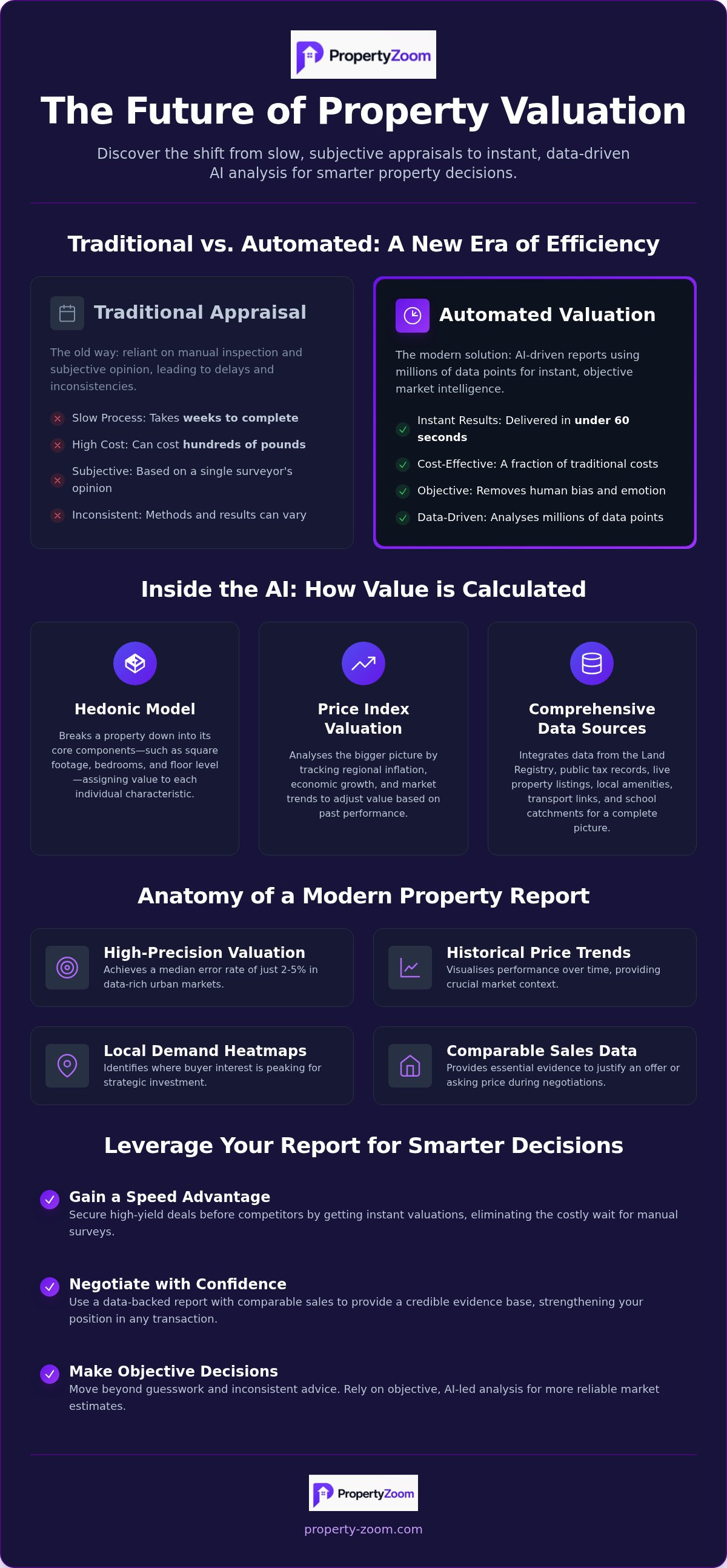
An automated property valuation report is a sophisticated digital estimate of a property's market worth, generated by complex algorithms rather than manual inspection. To grasp the underlying technology, you can explore What is an Automated Valuation Model (AVM), which details how these systems process massive datasets to remove human bias. By 2026, the transition from subjective, manual appraisals to objective AI-led analysis has become the industry standard. Whilst traditional methods rely on the limited experience of a single surveyor, AI leverages millions of data points to provide a neutral, data-driven perspective that investors trust for rapid scaling.
These reports aggregate multiple data streams to create a highly accurate picture of value:
- Sales History: Analysing recent transactions for similar properties in the immediate area.
- Local Market Trends: Tracking regional inflation and growth patterns to predict future performance.
- Property Characteristics: Accounting for square footage, floor level, and specific structural features.
In data-rich urban markets, leading models now achieve a median error rate of between 2% and 5%. This level of precision is why McKinsey projects a 40% growth in AI adoption across the real estate sector. For professional investors, this technology isn't just a convenience; it's a critical tool for rapid portfolio growth that bypasses the friction of old-school valuation methods.
The Anatomy of a Modern Property Report
A high-quality report provides more than just a single number. It delivers a breakdown of historical price trends and area analytics. Modern platforms use local demand heatmaps to show where buyer interest is peaking. You also receive a list of comparable sales, which is vital for justifying an offer. This transparency ensures everyone involved works from the same credible evidence base.
Why Speed Matters in the Current UK Market
The property market moves at a relentless pace. Waiting for a physical survey often means losing a high-yield deal to a faster competitor. An automated property valuation report provides the instant data needed to secure a property before others realise it's available. This speed also helps narrow the "valuation gap" that causes sales to collapse. By connecting reports to AI search tools, you can discover and value properties in one seamless journey.
How AI Calculates Value: Understanding the Models
An automated property valuation report isn't just a simple average of local prices. It relies on a multi-layered approach to ensure precision. One primary method is the Hedonic Model. This system breaks a property down into its constituent parts, such as square footage, the number of bedrooms, and even the specific floor level in an apartment block. By assigning value to these individual characteristics, the AI builds a granular estimate of what the property is worth based on its physical profile.
Another critical component is Price Index Valuation. This model looks at the bigger picture, adjusting the property's previous sale price based on regional inflation and economic growth. It's particularly useful in fast-moving UK markets where prices can shift significantly in a single quarter. To provide the most robust results, PropertyZoom uses ZEBA AI to blend these data streams. This combined approach ensures that both the specific features of the home and the broader market context are perfectly balanced. You can see how this fits into the wider industry by reading about Governing automated valuation models, which highlights the importance of algorithmic integrity in modern lending.
Data Sources Behind the AI
The accuracy of any report depends on the quality of its inputs. In the UK, AI models integrate directly with Land Registry data and public tax records. They also ingest real-time listing data from residential and commercial hubs to stay current with live market behaviour. Beyond the bricks and mortar, the logic accounts for local amenities, transport links, and school catchments. These external factors often carry significant weight in a property's final valuation, and AI is uniquely equipped to track these variables across thousands of locations simultaneously.
The Myth of AI Inaccuracy
Some critics suggest that automated reports are merely "guessing" without seeing the property. This is a misconception. Machine learning actually eliminates the human bias that often creeps into traditional appraisals. Whilst a surveyor might have personal preferences or inconsistent methods, an algorithm remains objective and consistent. The Confidence Score is the statistical probability of the valuation matching a physical appraisal. When you see a score of 90/100, it signals a high level of reliability that lenders and investors can act upon immediately. To see this technology in action, you can generate your own AI valuation and check the confidence rating for your specific postcode.
AVM vs. Traditional Surveyor: A Comparison
Choosing between a digital algorithm and a human surveyor depends entirely on your current stage in the property journey. An automated property valuation report excels at delivering high-speed, data-driven insights that a human simply cannot match in volume or velocity. Whilst a RICS-qualified surveyor provides a deep physical inspection, they typically require between five and ten working days to return a full report. In a competitive market, that delay can be the difference between securing a high-yield asset and losing it to a faster buyer.
The cost profile also differs vastly. Traditional physical surveys in 2026 often cost between £300 and £800, with some complex markets reaching even higher. In contrast, AI-driven valuations offer a significantly lower entry point for those who need to assess multiple opportunities simultaneously. The future of property investment is hybrid. Smart investors use AI to shortlist properties and perform initial due diligence, only paying for a physical surveyor once a deal is close to completion and requires a structural sign-off.
When to Rely Solely on an Automated Report
For the initial offer stages, speed is your greatest asset. Using an automated report allows you to perform desktop due diligence on dozens of listings in a single afternoon. It's the most efficient way to monitor the ongoing value of your current property portfolio without the logistical headache of booking site visits. If you're analysing niche land or commercial opportunities, the AI's ability to process regional growth data provides a clearer picture of long-term investment potential than a single physical inspection might reveal.
When to Instruct a Physical Surveyor
Algorithms cannot see "hidden" damp or structural cracks. You should always instruct a physical surveyor when you need to identify specific defects that could lead to costly repairs. Most lenders also require a formal, physical appraisal to finalise high-value mortgage applications to satisfy specific regulatory standards. Once a surveyor uncovers physical issues, you can use their findings to negotiate significant price drops. This ensures you aren't overpaying for a property that requires immediate capital expenditure for structural maintenance.
Step-by-Step: Generating and Interpreting Your Report
Generating an automated property valuation report takes less time than making a cup of tea. The journey begins with our conversational AI search. Instead of filling out tedious, multi-page forms, you simply describe the property or paste a listing URL. The system uses natural language processing to extract key features and immediately cross-references millions of UK data points. It's a streamlined, user-friendly entry point into high-level property analytics that removes traditional barriers to information.
Once the data is processed, you'll receive a base valuation alongside a proprietary Investment Score. This score evaluates the property's growth potential by looking at wider economic indicators and historical performance. You must then review the "Comparables" section. This lists similar properties that have recently sold or are currently on the market, providing the necessary context for your valuation. Finally, factor in niche data points. If you're looking at land or commercial opportunities, the report highlights student housing yields or commercial development potential that a general appraisal might overlook.
Reading Between the Lines of an Investment Score
A high Investment Score indicates more than just a good price. It signals high rental demand and strong capital growth prospects. This tool is particularly effective for identifying "under-valued" gems in emerging UK postcodes before they hit the mainstream. By linking these findings to a sophisticated AI Property Search Platform, you can filter for high-yield assets that match your specific risk profile. It transforms a static number into a live investment strategy that evolves with the market.
Customising the Report for Your Goals
Every investor has a different objective when they run an automated property valuation report. You can adjust the parameters to compare the returns of "Contractor Stays" against traditional long-term residential lets. Sellers also benefit by using these reports to set a realistic, data-backed asking price. Research from 2026 indicates that approximately 15% of homeowners who request an automated valuation end up listing their property within the following year. For estate agents, the integration of Zeba Calls AI ensures that valuation leads are followed up instantly, converting interest into instructions. This level of customisation ensures the data serves your specific financial goals.
Ready to see the data for yourself? Generate your instant property report today and start making smarter decisions with total clarity.
From Valuation to Transaction: Your Next Steps
An automated property valuation report is a tactical roadmap for negotiation. It functions as a credible "Proof of Value" that you can present to sellers or estate agents to justify your offer. This objective evidence helps bridge the gap between a seller's expectations and the actual market reality. By using data-backed insights, you eliminate the emotional friction that often derails transactions. It positions you as a sophisticated buyer who understands the nuances of local demand and historical price trends with total clarity.
Securing finance is the next logical step. Since the introduction of new quality control standards for AVMs in late 2025, lenders have become increasingly confident in AI-verified property data. This regulatory shift ensures that your report meets high standards for accuracy and integrity. Within the PropertyZoom ecosystem, you can transition seamlessly from your valuation to securing mortgages. The platform connects your data with brokers who specialise in high-yield investments, ensuring your financial application is supported by the most current market metrics.
Streamlining the Legal and Surveying Process
Streamlining the legal and surveying process is essential for maintaining momentum. You can share your report directly with solicitors to kickstart the legal conveyancing phase without waiting for manual data entry. Integrating digital surveying at this stage creates a comprehensive property profile that covers both financial value and physical condition. This unified workflow reduces the standard time-to-completion by removing the need for repetitive data requests. It ensures that every stakeholder, from the broker to the solicitor, operates from a single source of truth.
The Future of AI-Driven Property Ownership
The future of property ownership is proactive, not reactive. Successful investors use AI to manage commercial and student accommodation portfolios with minimal manual oversight. You can set automated alerts to monitor value changes in your area, allowing you to react instantly to market growth. This data also informs your asset management strategy. Whether you're planning structural renovations or transitioning a property into a "Contractor Stay" listing, your report provides the data needed to maximise capital growth and rental yields.
Get your instant automated property valuation on PropertyZoom today and take control of your next property transaction with confidence.
Secure Your Advantage in the 2026 Market
You now have the tools to bypass the slow, subjective methods of the past. By leveraging an automated property valuation report, you gain an immediate edge in a competitive landscape. You can identify high-yield opportunities in student accommodation or commercial land whilst others are still waiting for a physical appointment. Our platform provides the clarity you need to move from data to a completed transaction with total confidence.
Powered by ZEBA AI for 2026 market accuracy, PropertyZoom ensures your investment decisions are backed by the most sophisticated models available. We offer a complete ecosystem that handles everything from niche searches to legal conveyancing and mortgage referrals. It's time to stop guessing and start building your portfolio with precision. Start your smart property search and get an instant valuation today. The path to a more efficient and profitable property journey is ready when you are.
Frequently Asked Questions
How accurate is an automated property valuation report compared to an estate agent?
An automated property valuation report is often more objective than an estate agent because it eliminates human bias and emotional pricing. Whilst agents rely on local experience, AI analyses millions of data points including historical sales and real-time market trends. In liquid urban markets, these reports achieve a median error rate of 2% to 5%. This data-driven approach provides a neutral baseline that agents often use to justify their own valuations.
Will a bank accept an AVM report for a mortgage application?
Most banks now utilise AVMs for initial desktop valuations and risk assessments. Following the federal quality control standards established in late 2025, the industry has seen increased trust in AI-driven estimates. However, for final mortgage approval on high-value or unique properties, a lender may still require a physical appraisal. The automated property valuation report serves as a critical first step in the lending process by providing instant, credible data.
Does the automated report take into account recent home improvements?
Standard models traditionally struggle with internal decor, but PropertyZoom's conversational AI search allows you to input specific upgrades. You can mention new extensions, kitchen renovations, or energy-efficiency improvements during the search process. The AI then adjusts the valuation based on how these specific features typically impact market value in your postcode. This ensures your report reflects the actual condition of the property rather than just relying on historical averages.
Can I get a valuation report for commercial land or student housing?
Yes, you can generate reports for niche assets including commercial land and student accommodation. PropertyZoom features specialised listings for these sectors, and the ZEBA AI technology accounts for specific yield metrics unique to student housing. Unlike standard residential tools, our models analyse commercial potential and land development values. This makes it an essential resource for professional investors looking to scale portfolios beyond traditional residential lets in the UK market.
How often is the data in an automated valuation report updated?
Data is refreshed in real-time as new information becomes available from the Land Registry and active market listings. Our system continuously ingests transaction records and price changes to ensure the most current market behaviour is reflected. This high frequency prevents the valuation lag often found in traditional quarterly reports. You get a snapshot of the market as it exists today, not a reflection of how it was three months ago.
What is a "Confidence Score" in a property valuation report?
A Confidence Score is a metric, typically ranging from 1 to 100, that indicates the statistical probability of the AI valuation matching a physical appraisal. A score of 90 or above suggests a very high level of data availability and accuracy for that specific property. If the score is lower, it usually means the property is unique or located in a data-poor area, suggesting a physical survey might be beneficial for finalising details.
Is an automated valuation report free to generate?
Access to basic valuation estimates is often available for casual users, whilst professional investors and agents typically pay platform access fees for detailed reports. PropertyZoom operates on a subscription model for heavy users, providing deeper insights and Investment Scores. We also generate revenue through referral commissions for integrated services like legal conveyancing and surveying. This allows us to maintain a high-tech assistant that remains accessible to all participants in the property market.
How does PropertyZoom’s AI differ from standard online valuation tools?
PropertyZoom differs by moving beyond simple price estimates to provide comprehensive Investment Scores. Powered by ZEBA AI, our platform integrates conversational search with a full ecosystem of professional services. Standard tools often provide a static number without context, whereas we offer a roadmap for the entire transaction. From initial search to legal conveyancing and mortgages, our AI acts as a smart assistant that simplifies the journey from start to finish.


