

In 2026, the most valuable tool for securing residential land for sale UK isn't a deep pocket, but a faster algorithm. You already know that the traditional hunt for development plots is often a game of luck and exhausting manual labour. Between opaque planning permissions and aggressive competition from volume builders, finding a site with genuine potential feels like an uphill battle. It's stressful to watch prime opportunities vanish while you're still trying to calculate a fair market value or assess hidden risks.
This guide changes that dynamic. You'll discover how to master the modern market with technological confidence, using AI to strip away the complexity of land acquisition. We'll show you how to identify high-yield plots instantly and use data-driven insights to bypass traditional barriers. You'll learn to secure instant valuations, understand the full scope of acquisition costs, and streamline your search and due diligence process. It's time to move with more speed and less stress.
Key Takeaways
- Learn to navigate the 2026 planning landscape by understanding the shift towards brownfield residential conversion and new fast-track rules.
- Discover how conversational AI tools surface high-potential residential land for sale UK that traditional search filters often miss.
- Master a precise due diligence roadmap to verify title deeds and manage topographical risks before committing capital.
- Use instant AI valuations and investment scores to calculate accurate development ROI and ensure you never overpay for raw land.
- Streamline your acquisition process by integrating legal, surveying, and mortgage workflows into a single, efficient digital journey.
Understanding the UK Residential Land Market in 2026
The 2026 land market operates on a data-first principle. Acquiring residential land for sale UK requires more than a keen eye; it demands an understanding of how environmental mandates and economic shifts dictate value. Supply remains tight, particularly in the Home Counties where demand is driven by a lack of available plots and stringent Green Belt protections. When searching for residential land for sale UK, savvy buyers prioritise sites with pre-existing infrastructure to offset rising material costs.
Environmental compliance is now a non-negotiable cost. Nutrient Neutrality and Biodiversity Net Gain (BNG) requirements are no longer secondary considerations. In 2026, these factors directly impact the viability of a site. If a plot cannot meet the 10% BNG threshold or mitigate its nitrogen footprint, its valuation drops significantly. Modern buyers use AI tools to assess these risks before making an offer, ensuring they don't inherit expensive ecological liabilities.
Key Land Classifications for Residential Use
Plots generally fall into three categories: Greenfield, Brownfield, or Infill. Greenfield sites offer a blank canvas but face the toughest planning hurdles. Brownfield sites are the 2026 priority. Government incentives and fast-track conversion rules make these urban regeneration projects highly attractive. Infill plots, located between existing buildings, offer the lowest risk but smaller scale.
Investors must distinguish between strategic land and immediate development plots. Strategic land is a long-term play, often involving agricultural sites with "Hope Value." This is the speculative premium paid on the chance that the land will eventually receive planning permission. Immediate plots are spade-ready, commanding higher prices but offering faster liquidity and lower planning risk.
Regional Hotspots for Residential Development
Location remains king, but the map has shifted. Following major rail infrastructure upgrades, commuter belt towns have seen a surge in interest. These areas provide a balance of lower entry costs and high demand for family housing. The Northern Powerhouse regions also continue to deliver high residential yields. Cities like Manchester and Leeds are focal points for urban expansion, where brownfield incentives are most aggressive.
Coastal land remains a niche but profitable sector. Whilst scenic value is high, developers must account for stricter environmental restrictions and flood risk assessments that are standard in 2026. Success in these regions depends on using real-time data to identify plots where demand outstrips the local housing supply.
Identifying High-Potential Plots: Planning and Permissions
Acquiring raw land is a gamble, but securing a plot with permission is a strategic investment. When browsing residential land for sale UK, you must distinguish between Outline Planning Permission (OPP) and Full Planning Permission (FPP). OPP confirms the principle of development, giving you a broad "yes" from the council. FPP is more rigorous, covering every detail from drainage to architectural style. In the fast-moving 2026 market, FPP is the gold standard for immediate construction, whilst OPP offers more flexibility to customise the final build.
The 2026 regulatory shift has introduced "Fast-Track" rules specifically for brownfield residential conversion. These rules prioritise the reuse of previously developed land in urban centres, significantly reducing the bureaucratic wait times that once plagued these projects. Before you bid on any residential land for sale UK, consult the local authority's Development Plan. This document reveals the council's long-term vision for the area. You should also scan for hidden constraints such as Tree Preservation Orders (TPOs), Sites of Special Scientific Interest (SSSIs), and easements that might grant utility companies access across your site.
Navigating the Planning Application Process
Pre-application advice is your most valuable asset. It provides a formal steer from planning officers before you submit a full bid, potentially saving thousands in redesign fees. In 2026, working with planning consultants who understand local Community Infrastructure Levy (CIL) rates is essential. CIL is a non-negotiable charge based on the square footage of your development. Failing to factor this into your initial budget can instantly erode your profit margins. Before committing to a purchase, use AI-driven investment scores to see how these planning factors influence your total acquisition cost.
Permitted Development Rights for 2026
Permitted Development (PD) rights allow for certain types of work without a full planning application. Class Q rights remain highly popular for rural acquisitions, enabling the conversion of agricultural buildings into residential dwellings. In urban areas, airspace development is the new frontier, allowing developers to add new residential units to the tops of existing commercial or residential blocks. However, always check for Article 4 Directions. These are legal instruments used by local authorities to withdraw specific PD rights in a designated area, forcing you back into the full planning process.
Traditional Search vs AI-Powered Land Search
Finding residential land for sale UK used to be a full-time job. Investors spent hours toggling filters on traditional portals, hoping the right plot didn't fall through the cracks of a rigid database. In 2026, this manual approach is obsolete. High-tech assistants now handle the heavy lifting, shifting the focus from basic keyword matching to "intent-based discovery." This transition reduces search times from hours to seconds, allowing you to act while competitors are still loading their maps.
The 2026 market moves too quickly for traditional methods. Real-time data is now the only way to maintain a competitive edge. AI-driven tools don't just list plots; they interpret them. They understand the relationship between a plot's location, its planning history, and its current market value. This intelligence provides a level of clarity that manual searching simply cannot match, turning a complex hunt into a streamlined digital workflow.
The Limitations of Manual Property Filters
Rigid filters create significant blind spots for land buyers. If you set a price cap at £500,000, you'll miss a £510,000 plot that might be undervalued by 20% based on its development potential. Portals often suffer from "filter fatigue," where complex requirements lead to zero results because the system can't interpret nuances. Niche listings, such as multi-use plots or those with specific ecological constraints, often get buried under generic categorisations. Manual searches require you to know exactly what you're looking for, which is a major disadvantage when looking for residential land for sale UK with "hidden" value.
Leveraging AI for Smarter Land Discovery
Conversational AI removes these traditional barriers. Instead of ticking boxes, you describe your investment goal in natural language. You might ask for "land with development potential near transport hubs in the South East" or "brownfield sites with fast-track conversion eligibility." The system understands the context and surfaces opportunities that don't fit into standard categories. This is why PropertyZoom integrates an AI property search platform to deliver results with pinpoint accuracy.
This technology also enables personalised alerts that learn from your behaviour. The more you interact with the platform, the better it understands your risk profile and ROI targets. You receive a curated feed of high-potential sites, complete with investment scores and instant valuations. It's a faster, more intelligent way to build a land portfolio without the stress of manual due diligence.
The Due Diligence Roadmap for UK Land Buyers
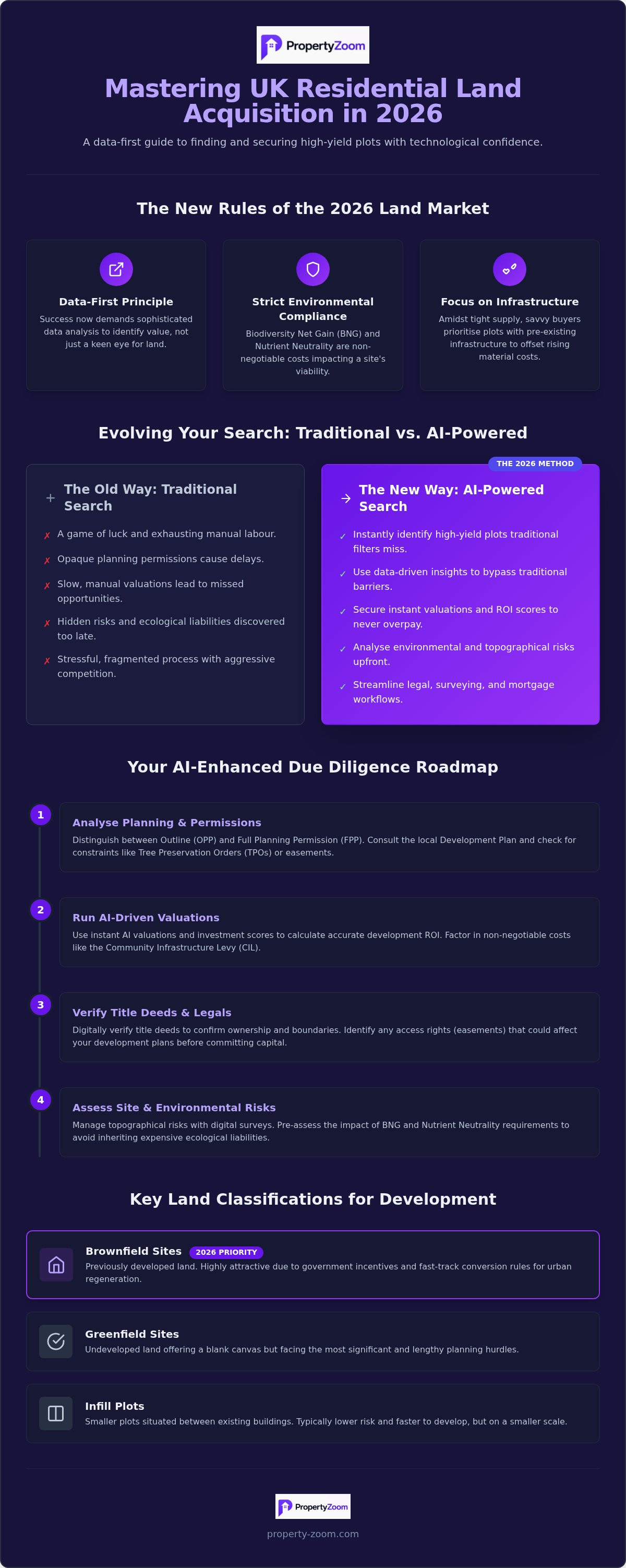
Successful acquisition of residential land for sale UK requires a methodical approach to risk management. You can't afford to overlook the fine print. Start by verifying title deeds and boundaries via the Land Registry. Discrepancies here can stall a project for months or lead to costly legal disputes. Next, conduct environmental and topographical surveys to understand the physical constraints of the site. These steps feed into your Total Cost of Development (TCD), which is the only figure that truly matters for your ROI. Secure legal conveyancing with land-specialist solicitors who understand the nuances of development contracts. Finally, finalise your financing and calculate your Stamp Duty Land Tax (SDLT) obligations. In 2026, current thresholds for non-residential land being converted are a critical factor in your initial capital outlay.
Essential Surveys and Technical Reports
Soil analysis is mandatory for brownfield sites to check for contamination or unstable ground. Topographical reports ensure your architectural plans are actually buildable on the terrain. Utility connectivity is often the most significant hidden cost. Bringing power, water, and high-speed fibre to a remote site can add tens of thousands to your budget. Refer to our land for sale investment deals checklist for a full breakdown of the technical requirements you'll need to satisfy.
Financial Planning and Tax Efficiency
SDLT rates vary between mixed-use and pure residential land. If you're buying a site with an existing structure, you might qualify for specific relief schemes. VAT is another complex area; whilst new builds are generally zero-rated, the recovery of VAT on professional fees requires careful structuring. For those looking at smaller plots, self-build mortgages or specialised development finance offer the liquidity needed to move from acquisition to construction. It's essential to have your finance in place before entering a competitive bidding war for residential land for sale UK.
Streamline your due diligence by accessing our network of legal, surveying, and mortgage experts directly through the platform.
How PropertyZoom Simplifies Residential Land Acquisition
PropertyZoom acts as your high-tech assistant, turning a fragmented process into a single digital workflow. Finding residential land for sale UK is only half the battle; the real challenge lies in speed and accuracy. Our platform uses Zeba Calls AI to ensure you're the first to reach agents when new listings hit the market. This immediate lead capture gives you a head start in a competitive 2026 environment. Once you identify a plot, our system provides instant land valuations and investment scores, ensuring you never overpay or waste time on low-yield opportunities.
We've built an ecosystem that removes traditional barriers to entry. By integrating conversational search with real-time data, we provide the clarity needed to make fast, confident decisions. You no longer need to juggle multiple platforms or wait days for professional feedback. Everything you need to evaluate and secure a plot is available in seconds, allowing you to focus on development rather than administration.
Data-Driven Decision Making with Investment Scores
Traditional land buying relies on gut feeling and manual research. PropertyZoom replaces this with data-driven clarity. Our AI analyses local planning success rates and historical market trends to generate an investment score for every plot. This score ranks land based on its true development ROI, accounting for regional demand and regulatory constraints. It's a pragmatic way to filter out high-risk sites before you spend a penny on surveys.
Understanding the accuracy of instant property valuation online is vital when negotiating. You gain the confidence to walk away from overpriced sites or secure a deal with facts rather than guesswork. By leveraging these metrics, you can negotiate better prices based on verifiable performance data rather than agent estimates. This transparency reduces the stress of the valuation process and protects your profit margins.
A Seamless Path from Search to Completion
The journey from identifying residential land for sale UK to breaking ground involves a complex web of professionals. PropertyZoom removes the friction by connecting your search directly to surveying, legal, and mortgage services. With one click, you can access a network of verified land-specialist surveyors and conveyancers who understand the 2026 regulatory landscape. This integrated approach ensures that your due diligence happens as fast as your search.
We automate the logistical side of acquisition. Integrated calendars allow for instant appointment booking, removing the back-and-forth of traditional scheduling. You can manage your entire land portfolio through our smart real estate tools, keeping all your due diligence, valuations, and legal documents in one secure hub. This ecosystem ensures your acquisition is not just smart, but entirely seamless.
Master Your 2026 Land Acquisition Strategy
The 2026 market demands a shift from manual searching to intelligent acquisition. You've seen how brownfield incentives and fast-track planning rules prioritise speed, whilst AI-powered tools remove the traditional friction of site discovery. Success no longer depends on how many hours you spend on portals; it's about how quickly you can interpret the data. By mastering the due diligence roadmap and leveraging real-time valuations, you protect your margins and secure the best residential land for sale UK before the competition even notices it's available.
PropertyZoom streamlines this entire journey. Our platform provides AI-driven investment scores for every listing, ensuring you focus only on high-potential plots. You gain direct access to expert legal and surveying referrals, all powered by ZEBA AI technology to keep you ahead of the curve. It's time to replace the stress of the unknown with the clarity of a data-backed plan.
Start your AI-powered land search on PropertyZoom today and turn complex data into your next successful development. Your next high-yield project is just a search away.
Frequently Asked Questions
Can I build a house on any residential land for sale in the UK?
No, you cannot build on land simply because it is marketed for residential use. You must secure planning permission from the local authority before any construction begins. Some plots are sold as strategic land, which means they have long-term potential but no current right to build. You should also check for restrictive covenants or legal easements that might prevent development even if planning is granted by the council.
What is the difference between land with planning permission and land without?
Permission significantly reduces your development risk and increases the land's market value. Land with Full Planning Permission is ready for immediate construction according to approved designs. Land without permission is speculative and usually much cheaper; however, there is no guarantee you will ever be allowed to build. Securing permission after purchase can be a lengthy, expensive process involving architects, consultants, and local planning officers with no certain outcome.
How much does it cost to get planning permission in 2026?
Costs vary depending on the scale of your project and the specific local authority fees. You must budget for the application fee itself, alongside professional costs for architectural drawings and technical reports. In 2026, new mandates for Biodiversity Net Gain and Nutrient Neutrality have increased the need for specialised ecological surveys. These professional fees often make up the largest portion of your pre-development budget, regardless of the plot size.
Is it harder to get a mortgage for land than for a house?
Yes, traditional residential mortgages are rarely available for raw land. Lenders consider land a higher risk because it doesn't provide the immediate security of a finished building. You will typically need a specialised self-build mortgage or development finance. These products often require a larger deposit, sometimes up to 50% of the land value, and funds are usually released in stages as your construction project reaches specific milestones.
What is the "Green Belt" and can I ever build on it?
The Green Belt is protected land intended to prevent urban sprawl and preserve the countryside. Building on these plots is strictly controlled and generally prohibited by national policy. You can only build on Green Belt land if you prove "very special circumstances," which is a high legal bar to clear. However, certain 2026 planning exceptions may allow for the redevelopment of brownfield sites or limited infill projects within established Green Belt boundaries.
How does PropertyZoom calculate land investment scores?
Our platform uses advanced algorithms to analyse local planning success rates, historical price growth, and current market demand. Powered by ZEBA AI technology, these scores rank residential land for sale UK based on its projected development ROI. This data-driven approach allows you to compare different plots instantly. It removes the guesswork by highlighting sites with the best balance of low planning risk and high capital growth potential in the 2026 market.
What taxes do I need to pay when buying residential land?
You are required to pay Stamp Duty Land Tax (SDLT) on any land purchase over the current government thresholds. In 2026, the rates depend on whether the land is classified as residential, non-residential, or mixed-use at the time of sale. You should also consider VAT implications; whilst many new-build projects are zero-rated, you may still pay VAT on professional fees. Always consult a tax specialist to understand your total liability before completing a purchase.
How do I check if a plot of land has access to utilities?
You should conduct a formal utilities search during your due diligence process. This involves contacting local providers to identify connection points for electricity, water, gas, and fibre broadband. PropertyZoom can refer you to professional surveyors who specialise in technical site assessments. They will verify if the residential land for sale UK you are considering has viable access to the grid or if the cost of bringing services to the site will be prohibitive.


