

Searching standard commercial portals to find land for development is the quickest route to bidding wars and squeezed margins. When a parcel hits public listings, dozens of competing buyers are already calculating their bids. You spend weeks unpicking opaque planning histories, digging through clunky council registries, and discovering hidden site constraints far too late. It is a slow, frustrating grind that stalls your pipeline and wastes valuable capital.
Profitable site sourcing demands a smarter, data-led approach. In this guide, you will discover how modern property developers source, evaluate, and acquire profitable development land using real-time intelligence. Instead of chasing stale leads, you can pinpoint high-yield opportunities before the wider market even knows they exist.
We will break down actionable sourcing strategies for 2026, showing you how to unlock off-market sites, validate planning viability, and accurately assess gross development value. You will also learn how to streamline your entire acquisition process, moving seamlessly from digital discovery straight through to conveyancing.
Key Takeaways
- Discover the most effective channels to find land for development, shifting away from generic residential portals towards vetted commercial registers and digital platforms.
- Evaluate planning viability quickly with a structured four-stage framework covering outline permission, full consents, and permitted development rights.
- Calculate your maximum acquisition price with precision by applying residual land valuation models and localised gross development values.
- Filter high-yield parcel opportunities in seconds using conversational AI property search and real-time investment scores.
- Protect your capital during site acquisition by pairing flexible purchase contracts with integrated surveying, legal conveyancing, and finance.
Proven Channels to Find Land for Development in 2026
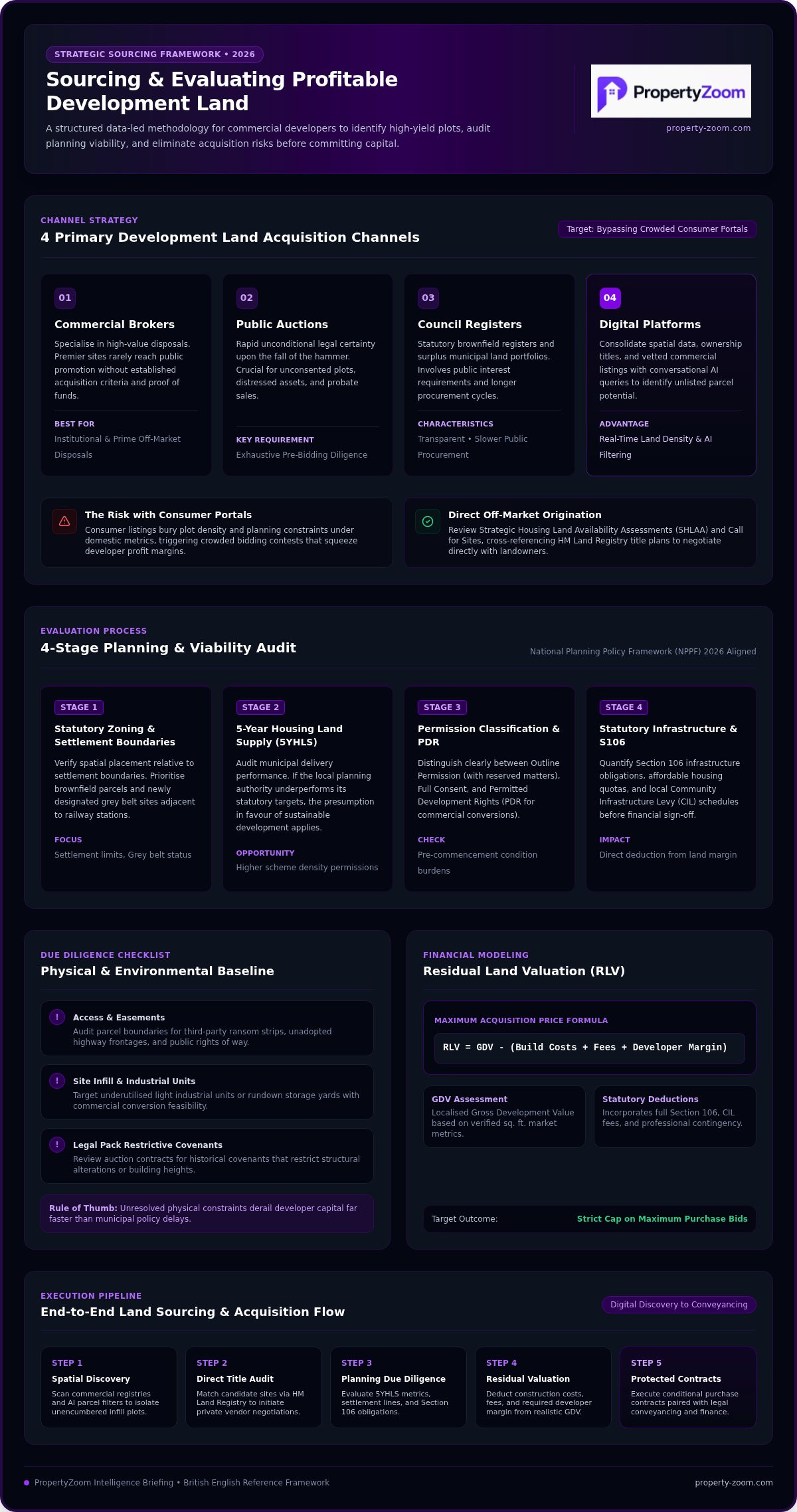
Traditional property portals cater to residential buyers, not commercial builders. Their search filters bury plot density, title splits, and planning constraints beneath irrelevant domestic metrics. To find land for development with genuine commercial margin, professional developers look beyond consumer marketplaces and tap into four primary deal channels:
- Commercial Brokers: Specialize in high-value disposals, though premier sites rarely reach public promotion without insider ties.
- Public Auction Houses: Offer rapid unconditional contracts, ideal for securing distressed assets if you complete diligence beforehand.
- Council Registers: Publish statutory brownfield registers and surplus municipal land, often tied to slower public procurement timelines.
- Specialised Digital Platforms: Consolidate spatial data, ownership records, and vetted Land and Commercial Listings in one interface.
Relying solely on consumer listings leads straight to crowded bidding contests. By contrast, accessing dedicated land inventories bypasses retail competition entirely, letting you analyse raw development potential without inflated residential premiums.
On-Market Sourcing: Auctions, Commercial Agents, and Portals
Auctions offer legal certainty when the hammer falls, making them an effective route for unconsented plots or probate sales. You must inspect legal packs thoroughly; short completion windows leave zero margin for unaddressed covenants or restrictive rights of way.
When working with commercial agents, demonstrate proof of funds and clear acquisition criteria to see institutional disposals before open marketing begins. Filtering out standard housing listings remains critical. Using an advanced AI property search platform allows you to bypass domestic listings and filter directly for land classifications, floor-area ratios, and commercial conversions matching your strategy.
Off-Market Discovery: Direct Vendor Contact and Local Plan Calls
The most lucrative development opportunities never reach public view. Understanding the wider land development process enables proactive developers to originate off-market sites directly. Start by reviewing your local council's Strategic Housing Land Availability Assessment (SHLAA) and recent Call for Sites submissions. These documents highlight parcels where landowners have already expressed an interest in selling.
Cross-reference these candidate sites with HM Land Registry title plans to identify corporate or individual owners. Target unencumbered infill plots, rundown light industrial units, or disused commercial storage yards. Direct vendor negotiations allow you to structure flexible purchase agreements, avoid public bidding wars, and secure plots below open-market price thresholds.
How to Assess Development Land Viability and Planning Status
When you find land for development, unravelling statutory viability separates profitable projects from stranded capital. Professional developers implement a rapid four-stage evaluation: verify statutory zoning designations, audit local housing delivery targets, inspect physical access constraints, and quantify statutory infrastructure contributions. Under the August 2026 National Planning Policy Framework (NPPF), local plan timelines matter less than spatial location within settlement boundaries, unlocking clearer development routes across brownfield parcels and newly classified grey belt land near railway stations.
Deconstructing Planning Permission and Zoning Designations
Never take stated planning status at face value. Outline planning permission confirms development principles, but onerous pre-commencement conditions and Section 106 infrastructure obligations can quickly erode gross margins. Differentiate between full consent, outline permissions with reserved matters, and Permitted Development Rights (PDR). Assess local planning precedent and municipal Five-Year Housing Land Supply data. If an authority underperforms its targets, planning presumption tilts in your favour, allowing higher density schemes than historic policies indicate.
Identifying Physical and Environmental Red Flags
Physical constraints derail acquisitions faster than municipal policy. Before signing legal paperwork, run through critical baseline checks:
- Access and Easements: Inspect boundaries for ransom strips, unadopted highway frontages, and restrictive rights of way.
- Ground Conditions: Commission desktop contamination reports to check historic industrial uses and unstable subterranean topography.
- Environmental Designations: Audit Environment Agency flood map zones and local Tree Preservation Orders (TPOs) early.
Reviewing historical ground use and statutory site risks mirrors the diligence required in an official land acquisition process. Note that small-scale brownfield developments under 0.2 hectares without priority habitats remain exempt from statutory Biodiversity Net Gain (BNG) burdens, protecting project schedules and remediation budgets. For verified parcel data and clear planning clarity, source prospective sites through PropertyZoom to evaluate opportunities with verified intelligence upfront.
Conducting Land Financial Appraisals and Investment Due Diligence
Historical farmland or commercial sales figures cannot establish what a development parcel is worth. When you find land for development, pricing precision comes from working backwards from end values. The residual land valuation model establishes your absolute ceiling acquisition price, ensuring you protect profit margins before entering contractual commitments.
Residual land value follows a strict arithmetic discipline: Gross Development Value (GDV) minus build costs, professional fees, finance charges, statutory contributions, and targeted developer margin. Establishing accurate baseline values early prevents overbidding on unconsented land. Review our detailed guide to instant property valuation online to benchmark local square-metre exit values using current market transactions.
The Residual Valuation Formula for Land Sourcing
Your primary objective is determining the maximum purchase price while protecting a 15% to 20% return on GDV. Start with localized unit pricing. Benchmark comparable local new-build transactions to calculate your realistic gross realization figure. Deduct baseline construction costs, adding a mandatory 10% contingency buffer to insulate against volatile building material expenses.
Factor in professional advisory fees spanning structural engineers, architects, planning consultants, and ecologists. Senior debt development finance currently prices between 6.5% and 9.5% per annum alongside lender arrangement fees of 1% to 2%. Incorporate these debt-servicing requirements directly into your cash-flow model to calculate true net residual land value.
Factoring Infrastructure Costs and Utility Connections
Overlooked ground works and statutory contributions can ruin a development appraisal. As part of a professional Financial Viability Assessment, quantify mandatory planning contributions alongside site-specific abnormal costs before finalising offers:
- Statutory Undertaker Connections: Secure early capacity checks for substations, clean water mains, and foul sewer connections.
- Planning Levies: Calculate local Community Infrastructure Levy (CIL) rates per square metre alongside negotiated Section 106 obligations.
- Abnormal Site Prep: Quantify retaining structures, drainage attenuation tanks, and ground remediation expenditure against potential brownfield grant assistance.
Deducting every infrastructure burden upfront ensures that your offer reflects true commercial realities, allowing you to find land for development that delivers viable returns through construction.
Accelerating Land Sourcing with AI Tools and Digital Intelligence
Manual planning checks and static spreadsheets slow acquisition pipelines down. In contrast, modern property developers rely on machine intelligence to find land for development in fractions of the time. Digital intelligence aggregates title deeds, local zoning rules, and spatial data into actionable insights, removing the friction of manual discovery.
By blending machine-learning queries with commercial asset data, developers can pinpoint redundant commercial footprints ripe for residential conversion under Class MA permitted development rules. Review our in-depth analysis of AI for commercial property valuation to benchmark commercial conversion opportunities accurately before negotiating asset purchases.
Conversational Search and Algorithmic Deal Scoring
Rigid portal dropdowns force developers to browse hundreds of non-viable plots. Conversational AI changes that workflow. You can input natural-language requirements directly, specifying target parameters like site dimensions, proximity to transport nodes, and preferred planning status:
- Natural-Language Filtering: Query complex constraints instantly, targeting brownfield plots suitable for medium-density schemes.
- Predictive Scoring: Leverage algorithmic Investment Scores to evaluate potential sites across active growth corridors.
- Spatial Intelligence: Surface underutilised infill plots by scanning municipal spatial maps alongside title boundaries.
Algorithmic deal scoring aggregates localized yield trends, buyer demand, and historic planning approval rates. Instead of assessing dozens of unviable sites manually, you prioritize parcels with the highest probability of delivery and margin preservation.
Curated Land and Commercial Listings on PropertyZoom
Sourcing efficiency hinges on data purity. Browsing unverified listings leads to wasted due diligence on unbuildable plots. PropertyZoom solves this issue through dedicated Land and Commercial Listings, built specifically for active property developers and commercial investors.
The platform pairs vetted commercial parcels with instant AI Valuations, delivering data-led exit pricing before you commit team resources. You can assess site yield metrics, review local development velocity, and shortlist sites matching strict hurdle rates within a single interface. Ready to modernize your sourcing pipeline? Explore PropertyZoom's AI property search to uncover vetted development opportunities today.
Executing the Acquisition: Surveys, Conveyancing, and Finance
Identifying an unlisted parcel is only the beginning. Once you find land for development, executing the acquisition cleanly determines whether your project succeeds. Structuring contracts intelligently limits financial exposure, whilst an integrated pipeline between surveying, legal conveyancing, and debt finance keeps completion on track. Learn how to streamline property buying by replacing fragmented professional handoffs with connected digital workflows.
Securing Land with Options and Conditional Contracts
Unconditional cash purchases expose developers to unnecessary planning risk. Professional operators deploy contractual structures that protect capital until statutory approvals are secured:
- Subject-to-Planning Contracts: Commit to buying the plot only after securing an implementable detailed planning permission.
- Option Agreements: Secure the legal right, but not the obligation, to purchase the site at an agreed price within a defined timeframe.
- Promotion Agreements: Fund the planning promotion upfront in return for an agreed percentage share of the open-market sale proceeds.
Always insert generous longstop dates. Factoring in local council planning committee backlogs ensures contracts do not lapse whilst awaiting statutory determination.
Connecting Surveying, Specialist Conveyancing, and Mortgages
Standard high-street solicitors frequently stall development transactions. They often lack the specialist expertise required to unpick complex overage clauses, agricultural tenancies, or historic rights of way. The PropertyZoom ecosystem links developers directly with specialist legal conveyancing and surveying professionals to resolve title defects before exchange.
Instruct measured boundary and topographical surveys immediately. Confirming access levels, tree canopy positions, and drainage runs eliminates costly architectural redesigns later. Coordinate your capital requirements in parallel. Securing commercial mortgages, development finance, or bridging facilities alongside survey sign-offs prevents last-minute funding shortfalls.
Take control of your pipeline today. Visit the platform and find your next development plot on PropertyZoom to evaluate, finance, and acquire viable land with complete confidence.
Transform Your Land Acquisition Strategy
Securing high-margin development sites requires leaving crowded public portals behind. Success hinges on unearthing off-market plots, testing planning viability against pro-growth policy frameworks, and calculating strict residual ceilings before committing capital. When you combine disciplined appraisal models with protective conditional contracts, you safeguard your cash flow and de-risk your entire build programme.
You don't have to navigate fragmented searches or disjointed professional handoffs alone. To find land for development with absolute precision, leverage PropertyZoom's specialised marketplace. Our platform pairs an advanced AI property search powered by ZEBA AI with dedicated Land and Commercial Listings, giving you immediate access to viable plots backed by instant valuations and investment scores. Integrated legal conveyancing, surveying, and mortgage services keep your entire acquisition pipeline moving smoothly from initial discovery right through to completion.
Explore Land and Commercial Listings on PropertyZoom and secure your next profitable development opportunity today.
Frequently Asked Questions
Can you build on land without planning permission?
You cannot build substantial new structures without planning permission or statutory permitted development rights. Certain agricultural buildings, minor boundary alterations, and specific commercial-to-residential conversions qualify under permitted development, but they still require prior local authority approval. Unauthorised building works trigger enforcement notices, statutory stop notices, or court orders mandating demolition, destroying capital and project viability.
How do I find off-market land for development?
You can uncover off-market opportunities by reviewing local authority Strategic Housing Land Availability Assessments (SHLAA) and cross-referencing parcel boundaries with HM Land Registry data. Contacting beneficial landowners directly bypasses competitive bidding. Using dedicated digital platforms that analyse zoning, spatial maps, and commercial asset yields helps developers find land for development before sites reach public listing portals.
What is the difference between greenfield and brownfield land?
Greenfield land consists of previously undeveloped agricultural or natural land, whereas brownfield sites are parcels that previously held permanent commercial, industrial, or residential structures. Greenfield sites often face stricter planning hurdles, biodiversity rules, and green belt designations. Brownfield parcels receive statutory planning presumption and streamlined support under national policy, making them popular choices for infill and regeneration schemes despite occasional ground contamination.
What is an option agreement in land development?
An option agreement is a legally binding contract granting a developer the exclusive right to purchase land at an agreed price within a set timeframe. Developers pay an upfront option fee to secure the site whilst funding planning applications at their own cost. If consent is refused, the developer can walk away without buying, limiting capital exposure strictly to professional planning fees.
How much deposit is required for a commercial land mortgage?
Lenders typically require a cash deposit between 30% and 50% for commercial land mortgages and acquisition finance. Loan-to-cost or loan-to-value limits depend heavily on planning consent status, with unconsented land requiring higher cash equity. Having detailed appraisals, experienced development teams, and viable exit routes helps secure competitive senior debt pricing and higher leverage from specialist commercial finance providers.
What checks are included in land legal conveyancing?
Land conveyancing conducts comprehensive title investigations to uncover restrictive covenants, overage agreements, mineral reservations, and rights of way across parcel boundaries. Specialist solicitors review local authority planning histories, environmental desktop screens, drainage easements, and highway adoptions. These detailed checks verify that the vendor holds unencumbered legal title and that no historic easements prevent your planned development layout from being built.
How does PropertyZoom use AI to find development land?
PropertyZoom integrates advanced ZEBA AI technology to let users find land for development through natural-language conversational search. The platform filters opportunities across parcel size, zoning, and location while generating instant algorithmic valuations and investment scores. Investors can browse curated Land and Commercial Listings and seamlessly instruct connected legal conveyancing, surveying, and mortgage partners within one continuous workflow.


