

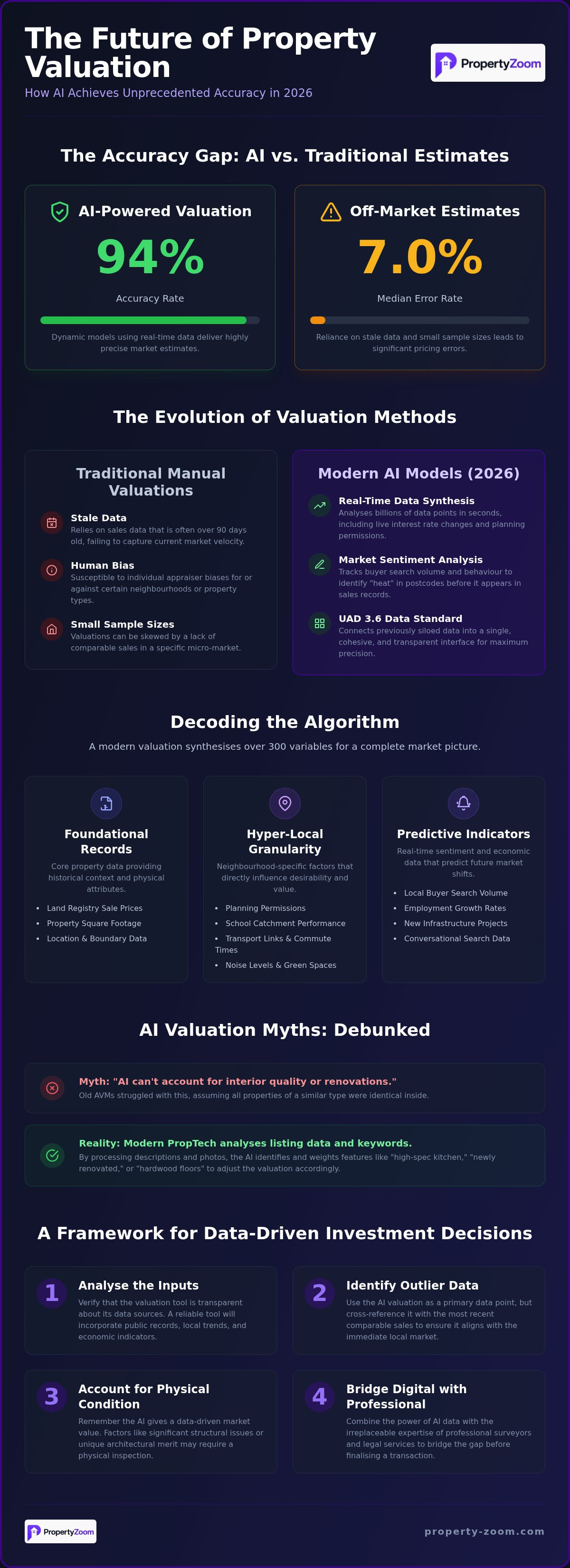
Did you know that AI-powered valuations can now achieve an accuracy rate of 94%, yet off-market estimates still carry a median error rate of around 7.0%? It is a significant gap that leaves many investors feeling uneasy. You have likely felt that same skepticism when faced with conflicting reports or "black box" algorithms that offer a price without any clear explanation. It is natural to worry about overpaying when the data feels opaque and the stakes are high.
By reading this, you will discover the truth behind automated valuations and learn how to use a modern property valuation accuracy tool to secure the most precise market data available. We will pull back the curtain on the algorithms and show you exactly where the numbers come from. This article provides a clear framework for verifying valuation data and explains the impact of the new UAD 3.6 data standards. You will finish with the confidence to use PropTech for your next big investment decision in 2026, backed by a deep understanding of the data sources behind the price.
Key Takeaways
- Understand how 2026 valuations have transitioned from static database lookups to dynamic AI modelling that reflects real-time market sentiment.
- Learn how a modern property valuation accuracy tool synthesises over 300 variables, including school catchments and demographics, to deliver precise estimates.
- Debunk common myths regarding AI's inability to recognise interior renovations and see how modern PropTech accounts for high-spec finishes.
- Master a proven framework to verify automated reports and identify outlier data, giving you the confidence to make data-driven investment decisions.
- Discover how combining AI valuations with professional surveying and legal services bridges the gap between digital data and transaction reality.
The Evolution of the Property Valuation Accuracy Tool in 2026
In 2026, a property valuation accuracy tool is no longer a simple calculator. It's a sophisticated engine that synthesises billions of data points in seconds. Traditional tools relied on a basic Automated Valuation Model (AVM) that looked at past sales. Whilst those models provided a starting point, they lacked the nuance of current market shifts. Today, we've moved into a digital property ecosystem where valuations are dynamic, not static. This shift means your property's value is calculated using real-time inputs rather than just historical records from three months ago. The transition from form-based reports to data-driven standards, like the mandatory UAD 3.6 format, has fundamentally changed how we define precision. This ecosystem connects disparate data silos, from local planning permissions to real-time interest rate fluctuations, into a single, cohesive interface that prioritises transparency.
Why Traditional Manual Valuations Often Miss the Mark
Manual valuations often suffer from inherent human bias. An appraiser might favour certain neighbourhoods or rely on a tiny sample of "comps" that don't truly reflect your home's unique features. The biggest issue is "stale data". In a fast-moving market, a sale from ninety days ago is ancient history. This lag time creates a gap between the reported price and what a buyer is actually willing to pay today. Manual reports simply cannot keep pace with the 2026 market's velocity. They often miss the subtle shifts in buyer sentiment that happen in weeks, not months. Traditional methods also struggle with small sample sizes. If only two similar houses sold in your area last year, a manual valuer has very little to work with. AI overcomes this by analysing broader patterns across similar micro-markets, ensuring your valuation isn't skewed by a single anomalous sale.
The Role of AI in Real-Time Market Sentiment Analysis
Modern AI doesn't just look at what happened; it predicts what's coming. By tracking buyer behaviour and search volume, a property valuation accuracy tool identifies heat in specific postcodes before it shows up in official land registry records. We now integrate social and economic indicators, such as local employment growth or new infrastructure projects, directly into the valuation. Even conversational search data serves as a lead indicator. If more people are asking about "solar-ready homes in Bristol," the AI adjusts the weighting for those features instantly. This level of precision ensures you aren't just looking at the past. You're making decisions based on the immediate future. It removes the guesswork and replaces it with a transparent, data-backed reality that empowers your investment strategy.
Decoding the Algorithm: How Modern Accuracy Tools Calculate Value
Understanding how a property valuation accuracy tool reaches a specific figure requires looking past the user interface. It isn't a single calculation. It's a multi-layered architecture that weighs hundreds of variables simultaneously. While location and square footage remain foundational, 2026 PropTech adds layers of context that traditional methods ignore. AI distinguishes between an ambitious asking price and actual market value by cross-referencing real-time transaction data. This process filters out the noise of market optimism to find the cold, hard truth of what a property is worth today.
Data Sources: From Public Records to Hyper-Local Trends
A sophisticated tool pulls from a vast array of digital feeds to build a complete profile. This includes:
- Land Registry records: Confirmed sale prices for historical context.
- Planning permissions: Insights into future developments that could boost or hinder value.
- Local amenities: Proximity to transport hubs, green spaces, and high-performing schools.
Beyond these basics, algorithms now process non-traditional data. Commute times are calculated using live traffic patterns. Noise levels are mapped from nearby infrastructure. The accuracy of automated models depends on this hyper-local granularity. It allows the system to track neighbourhood trajectory. If a postcode is seeing a surge in boutique cafes and tech startups, the AI recognises this shift months before it reflects in standard price-per-square-foot metrics.
The Importance of Investment Scores in Predictive Accuracy
Static valuations only tell you what a property is worth right now. A high-performing property valuation accuracy tool enhances this by integrating investment scores into the core logic. These scores serve as a unique differentiator. They combine yield predictions with capital growth forecasts to provide a forward-looking perspective. A property might have a high valuation today, but a low investment score could signal a stagnant market. Conversely, a high investment score can justify a premium price if the data predicts rapid appreciation. This predictive power helps you avoid value traps where a cheap property stays cheap. You can refine your strategy using our AI valuations to ensure every pound is backed by data-driven confidence.
5 Dangerous Myths About Online Property Valuations Debunked
Skepticism often surrounds digital property tools. Many people believe AI is just a glorified postcode average calculator. This is simply not true in 2026. A professional property valuation accuracy tool uses deep learning to identify patterns across millions of transactions. It isn't random; it's statistical precision. Modern models now analyse over 300 market factors, including real-time foot traffic and local economic growth. This data-driven approach allows for an accuracy rate of up to 94% for many properties, far exceeding the 85% seen in traditional manual appraisals just a few years ago.
Another common misconception is that these tools only serve sellers. In reality, a modern property valuation accuracy tool is vital for buyers who fear overpaying in a competitive market. Investors also rely on them to verify yield and capital growth potential. There's a persistent rumour that AI valuations are always 10% higher than the real market value. Verified data from 2026 shows this is false. For on-market homes, the median error rate is actually around 1.86% to 1.9%. The "always too high" myth usually stems from low-quality tools that don't have access to premium data feeds.
Myth: "AI Cannot See My New Kitchen"
Modern platforms have solved the "black box" visibility problem. You aren't stuck with whatever the algorithm guesses based on your neighbour's house. You can now input specific property facts to update the model. Photo-enhancement AI also plays a massive role. It scans uploaded images to recognise high-spec finishes, stone worktops, or premium flooring. Your input is the final piece of the accuracy puzzle. It bridges the gap between public records and your home's current condition, ensuring your valuation reflects the actual value added by your renovations.
Myth: "Digital Valuations Replace Surveyors"
Don't confuse market price with structural truth. A digital tool tells you what someone might pay; a surveyor tells you if the roof is about to collapse. You should use an automated property valuation report to prepare for your physical survey. It gives you a data-backed baseline to discuss with your professional. Within the PropertyZoom ecosystem, we combine this digital speed with human expertise. We offer direct access to surveying and legal services to verify the AI's findings. This synergy ensures you have both the data and the physical evidence before signing a contract.
A Framework for Verifying Your Property Valuation Accuracy
Triangulation is the only way to achieve certainty in a fast-moving market. A robust property valuation accuracy tool is your first line of defence against market volatility, but it shouldn't be your only one. You must validate the machine's logic against real-world evidence to avoid costly mistakes. Start with the "Rule of Three". Compare your primary report with a second independent AI platform and then consult a local agent. If these three figures align within a 5% margin, you have likely found the market truth. If there is a wider gap, you must dig into the underlying data to identify which source is the outlier. This systematic approach ensures you aren't just following a digital trend but making a calculated investment decision.
Cross-Referencing Comps with AI-Driven Investment Data
Don't just look at the number of bedrooms and the postcode. You need to verify that the "comparable" sales in your report are truly relevant. In 2026, a sale from six months ago is often ancient history. You require sales data from the last 30 to 60 days to reflect current market velocity. If similar homes are selling in under 14 days, the market is hot, and the valuation should reflect that momentum. You can also stress-test the capital value by looking at rental yields. If the local rent cannot comfortably cover a mortgage based on the suggested valuation, the price may be artificially inflated by short-term speculation. This back-calculation provides a vital reality check that many buyers overlook during their initial research.
Identifying Red Flags in Automated Valuation Outputs
High-quality tools provide a confidence score. If this score is below 80%, the data is likely thin or contradictory. You should also watch for the "Postcode Trap". This occurs when a tool is too broad, averaging a luxury development with a nearby industrial area. If your property valuation accuracy tool returns a figure that seems anomalous, it is time to interrogate the underlying variables. For more complex assets, such as those found in our Land and Commercial Listings, you must verify the output with specialised niche data. Missing data points, such as recent planning changes or local infrastructure shifts, are major red flags. Start your verification journey now by using our AI property search to see how our data-driven insights compare to your current reports.
Navigating the 2026 Market with PropertyZoom’s Precision AI
PropertyZoom isn't just a single feature; it's a unified ecosystem designed to eliminate guesswork from British real estate. By integrating AI Property Search with our sophisticated property valuation accuracy tool, we provide a seamless workflow for modern investors. You no longer need to jump between multiple platforms to verify a deal. Our platform brings AI Valuations and Investment Scores into a single, high-tech interface. This allows you to see the current market price alongside the long-term growth potential instantly. It's a pragmatic approach to a complex market, ensuring every decision you make is backed by the full weight of our ZEBA AI technology.
How Conversational Search Refines Valuation Accuracy
Traditional filters are often too rigid to capture the true value of a home. They cannot understand the nuance of a "south-facing garden" or "potential for a loft conversion" across a specific neighbourhood. This is where Zeba AI changes the game. Our conversational search understands the specific context of your requirements. You can ask, "What is the value of a 3-bed with a home office in this specific street?" The system doesn't just look at postcode averages; it parses hyper-local data to give you a tailored response. This refined search capability directly feeds into the property valuation accuracy tool, ensuring the data you see is relevant to your specific investment criteria rather than a generic estimate.
The Complete Ecosystem: From Valuation to Transaction
Accuracy is only useful if it leads to a successful transaction. We've removed the traditional barriers that typically slow down the buying process. Once you've used our tool to confirm a price, you can move straight to the next stage of your journey. Our platform provides direct access to professional surveying and legal conveyancing services. This bridges the gap between digital data and physical reality, giving you total confidence before you commit.
If you need to move quickly in a competitive market, Zeba Calls AI ensures you stay ahead by managing communications when the valuation is right. We even integrate smart mortgage applications based on our verified data. From the first search to the final legal sign-off, we provide a professional assistant that prioritises your time and peace of mind. It's a bold, efficient way to navigate the 2026 property market with absolute clarity.
Mastering the Future of Property Data
The 2026 property market moves too quickly for guesswork. You have seen how modern algorithms have evolved from simple postcode averages into sophisticated engines capable of high precision. By using a professional property valuation accuracy tool, you replace uncertainty with actionable intelligence. You now have the framework to verify automated reports and the insight to look beyond the asking price. The most successful investors don't just find data; they synthesise it using tools that bridge the gap between digital estimates and structural reality.
PropertyZoom empowers you with 24/7 conversational search and integrated investment scores to ensure you never miss a high-value opportunity. Our platform is powered by ZEBA AI technology, giving you a competitive edge in every transaction. Don't let skepticism hold back your growth. Take the first step toward a more intelligent investment strategy right now. Your next successful move is just a few clicks away.
Get your instant AI-powered property valuation on PropertyZoom today
Frequently Asked Questions
How accurate are online property valuation tools in 2026?
In 2026, a high-quality property valuation accuracy tool can achieve up to 94% accuracy for homes currently listed on the market. Off-market properties typically see a median error rate closer to 7.0% because there is less available data to process. These tools leverage over 300 variables, including real-time market sentiment and local economic indicators. They work best when you provide specific property facts, such as recent renovations, to refine the algorithm's output.
Can a property valuation accuracy tool account for local planning permissions?
Yes, advanced tools now integrate live planning permission feeds directly into their logic. If a new school or transport link is approved nearby, the algorithm adjusts the valuation to reflect the projected increase in demand. This real-time integration ensures your valuation isn't just based on historical sales but also on future growth drivers. It's a key feature that separates sophisticated AI platforms from basic postcode calculators that only look at the past.
Why do different websites give me different property valuations?
Discrepancies occur because each platform uses different data sources and weighting systems. One site might prioritise historical Land Registry data, whilst another focuses on real-time search volume and buyer behaviour. Some tools update their records daily, whereas others might have a lag of several weeks. PropertyZoom uses ZEBA AI technology to synthesise these disparate points into a single, verifiable truth, reducing the confusion caused by conflicting reports from less advanced sites.
Is an AI valuation legally binding for a mortgage application?
No, an AI valuation is an Automated Valuation Model (AVM) and is not legally binding for a mortgage. Lenders usually require a professional survey or a RICS-qualified appraisal before they approve a loan. However, the mandatory UAD 3.6 format introduced in 2026 makes digital data more central to the process. Use your AI report as a baseline to prepare for the physical inspection and to ensure your initial offer is realistic.
How often should I update my automated property valuation report?
You should refresh your report at least once a month in a volatile market. Prices can shift rapidly based on local demand and interest rate changes. It's also vital to update the data immediately after completing any significant home improvements, such as a new kitchen or an extension. Frequent updates ensure your property valuation accuracy tool is working with the most current facts, giving you a distinct edge during price negotiations.
What is the difference between a market estimate and an investment score?
A market estimate tells you what a property is worth today based on comparable sales. An investment score is a predictive metric that forecasts future capital growth and rental yields. PropertyZoom integrates these scores to help you identify value traps where the current price is high but the growth potential is low. This distinction is vital for investors who need to see beyond the immediate sticker price to find long-term profitability.
Can AI tools value commercial property or land accurately?
Yes, AI can value land and commercial properties, but it requires specialised datasets to be effective. These models achieve a median accuracy of 95-97% for conventional multifamily properties in major metropolitan areas. For vacant land or industrial units, the algorithm weighs factors like zoning laws and infrastructure access. PropertyZoom provides specific Land and Commercial Listings that utilise these niche data points to ensure the valuation reflects the asset's true commercial potential.
Do I still need an estate agent if I have an accuracy tool?
Yes, an accuracy tool is a powerful assistant, but it doesn't replace the local expertise of an estate agent. Agents provide the human nuance and negotiation skills needed to close a complex deal. The most effective strategy is to use PropertyZoom's data to arm yourself with facts before you speak to an agent. This combination of digital precision and professional service ensures you secure the best possible terms for your transaction.


