

In 2026, relying on manual spreadsheets for your commercial property investment analysis is no longer just slow; it is a financial risk. With commercial mortgage rates starting at 5.80% and a volatile economy shifting daily, the margin for human error has vanished. You need a faster, smarter way to identify opportunities in a market where investment volume has already climbed 19% this year.
You likely recognise the exhaustion of cross-referencing inconsistent listings whilst trying to forecast performance. It is a complex journey that often feels like guesswork. We believe that professional evaluation should be effortless and transparent; it is about removing the stress of manual data entry so you can focus on growth and strategy.
This guide promises to transform your workflow by introducing a repeatable framework that evaluates deals in minutes, not days. You will learn to use predictive investment scores and AI-driven insights to secure high-yield deals with confidence. We will explore how PropertyZoom’s sophisticated valuations and smart search tools provide the clarity you need to outpace the competition whilst analysing the market.
Key Takeaways
- Master the fundamental shift between risk mitigation and capital appreciation whilst understanding why commercial due diligence differs from residential models.
- Eliminate the high cost of human error by replacing manual spreadsheets with AI-driven insights that uncover hidden value in volatile markets.
- Build a repeatable framework for commercial property investment analysis using conversational AI filters to isolate high-yield opportunities instantly.
- Utilise proprietary Investment Scores and instant AI valuations to verify asking prices and forecast performance with institutional speed.
- Streamline your entire investment journey by integrating professional surveying, mortgages, and legal conveyancing into a single, digital workflow.
The Fundamentals of Commercial Property Investment Analysis
Successful commercial property investment analysis starts with a clear objective: balancing risk mitigation against capital appreciation. In the 2026 market, professional investors often prioritise income-driven returns over pure property value growth. With the 10-year Treasury yield sitting at 4.73% as of September 2026, every deal must be scrutinised for its ability to outperform baseline benchmarks. You're looking for stability in a landscape where total returns are increasingly driven by yield rather than speculative appreciation.
Commercial due diligence differs from residential analysis because the value is tied to lease terms and tenant quality rather than emotional appeal. You aren't just buying a building; you're buying a cash flow. This requires a deep understanding of real estate appraisal principles to ensure the underlying asset supports your financial goals. Macro-economic factors like the federal funds rate, held at 3.50% to 3.75% through July 2026, and commercial mortgage rates starting at 5.80% dictate your borrowing costs and exit strategies.
Asset Classes and Market Cycles
Identifying the right sector is critical for a high-yield portfolio. Whilst industrial properties saw a 13.2% price increase per square foot recently, retail and multifamily assets grew at more modest rates of around 7.4% to 7.6%. You must distinguish between traditional office spaces and high-growth niches like contractor stays or student accommodation. Each sub-sector responds differently to the current economic climate.
Market cycles no longer follow predictable ten-year patterns. They move at the speed of digital information. The old mantra of "location, location, location" has evolved. Today, it's "data, data, data." You need to know local demand metrics and vacancy rates in real-time to avoid catching a falling knife in a volatile economy. Identifying where a specific asset sits amongst these trends requires more than just a local scout; it requires a digital one.
The Shift from Manual to AI-Driven Due Diligence
Manual spreadsheets are a liability. They simply cannot keep up with the $117.3 billion in investment volume seen in the first quarter of 2026. Human error in a single cell can ruin a projection and lead to a poor acquisition. Modern commercial property investment analysis demands real-time data ingestion to maintain accuracy. If your data is a week old, your valuation is already obsolete.
PropertyZoom removes the manual slog by centralising disparate data points into a single ecosystem. From legal conveyancing details to instant valuations, the platform provides the clarity needed to navigate the $1.8 trillion in maturing commercial loans expected to hit the market. By using proprietary Investment Scores, you can grade deals instantly. This technology allows you to act with institutional speed, ensuring you don't miss high-yield opportunities whilst competitors are still stuck in data entry.
Key Metrics: Calculating Yield, Cap Rates, and NOI
Move away from academic theories and focus on the engine of the deal. Net Operating Income is the total income minus all necessary operating expenses before tax. It's the starting point for any commercial property investment analysis, providing a clear view of an asset's raw earning power before you factor in debt or taxes. In a 2026 market where multifamily property prices have risen by 7.4%, precision in these core numbers is the only way to protect your margins.
Net Operating Income (NOI) Breakdown
Revenue isn't just the base rent. You must account for every stream, including parking fees, service charges, and communication mast leases. Then, deduct the "leakage": insurance premiums, property taxes, and cyclical maintenance costs. In 2026, building owners must also factor in fluctuating energy costs and ESG-related upgrades. Net Operating Income is the total income minus all necessary operating expenses before tax.
Gross Initial Yield offers a quick snapshot, but it's often a deceptive metric. It ignores the heavy purchase costs and ongoing management fees that eat into your actual returns. Net Yield provides the reality; it accounts for legal fees, surveying, and stamp duty land tax. If you're planning a long-term hold, Internal Rate of Return (IRR) is your ultimate metric. It factors in the time value of money, which is vital when the 10-Year Treasury yield is at 4.73%.
The Cap Rate Comparison Framework
The Capitalisation Rate (Cap Rate) acts as your primary risk barometer. It's calculated by dividing the NOI by the current market value. A lower Cap Rate usually suggests a safer asset in a prime city centre, whilst a higher rate indicates more risk or a secondary location. Use this metric to compare different commercial assets in the same area to see which offers the best risk-adjusted return.
- Compare assets within the same sector to ensure a like-for-like analysis.
- Adjust your expectations based on lease length and tenant creditworthiness.
- Use AI valuations to benchmark your Cap Rate against local market averages instantly.
Manual benchmarking is too slow for today's pace. Data on industrial properties, which saw a 13.2% price increase in Q2 2026, changes weekly. AI tools ingest these shifts instantly, allowing you to compare a retail unit's Cap Rate against a warehouse in the same region within seconds. This level of precision separates institutional-grade investors from those who simply guess. It removes the guesswork and replaces it with a streamlined, data-driven workflow.
AI vs Manual Spreadsheets: Mitigating Risk in CRE Analysis
Manual spreadsheets are a legacy tool in a high-speed market. A single incorrect formula in your commercial property investment analysis can skew your projected yield and lead to a costly mistake. In 2026, the margin for error is non-existent. You need a system that removes human fallibility and replaces it with algorithmic precision. AI identifies hidden value by analysing patterns in local demand and tenant behaviour that manual reviews often overlook. Whilst a human might take hours to screen a handful of listings, AI processes thousands in seconds. This shift doesn't just save time; it changes your entire strategy from reactive to proactive.
Predictive analytics forecast future occupancy and rental growth by evaluating broader economic shifts. For instance, if a specific region sees a rise in business tax exemptions or infrastructure investment, AI factors this into the local demand forecast. It understands the relationship between policy changes and tenant interest better than any manual tracker. This foresight allows you to buy into emerging markets before the general crowd drives the price up, securing a first-mover advantage in a volatile economy.
Predictive Investment Scores
PropertyZoom’s AI generates instant Investment Scores by synthesising thousands of data points. These scores aren't just based on historical performance; they weight future potential based on predictive analytics. By forecasting occupancy rates and rental growth, the platform helps you prioritise your viewing schedule. You focus your energy on deals with the highest probability of success, leaving the low-yield noise behind. It is a more intelligent way of doing things, providing the technological confidence required to scale your portfolio without increasing your workload.
Automated Data Verification
Due diligence often stalls during the verification phase. AI accelerates this by automatically cross-referencing property records, planning permissions, and title deeds. Integrating digital surveying early in your analysis ensures you aren't blindsided by structural issues or legal hurdles later. For those seeking a more efficient discovery process, using an AI property search platform is the smarter way to find and invest in 2026.
This level of automation ensures your data is verified before you even step onto the site. You gain total peace of mind whilst maintaining the momentum of your investment journey. By linking surveying data directly into your analysis, you identify potential capital expenditure before making an offer. This integrated approach removes the traditional barriers between search, valuation, and legal conveyancing, making the entire process feel effortless and transparent.
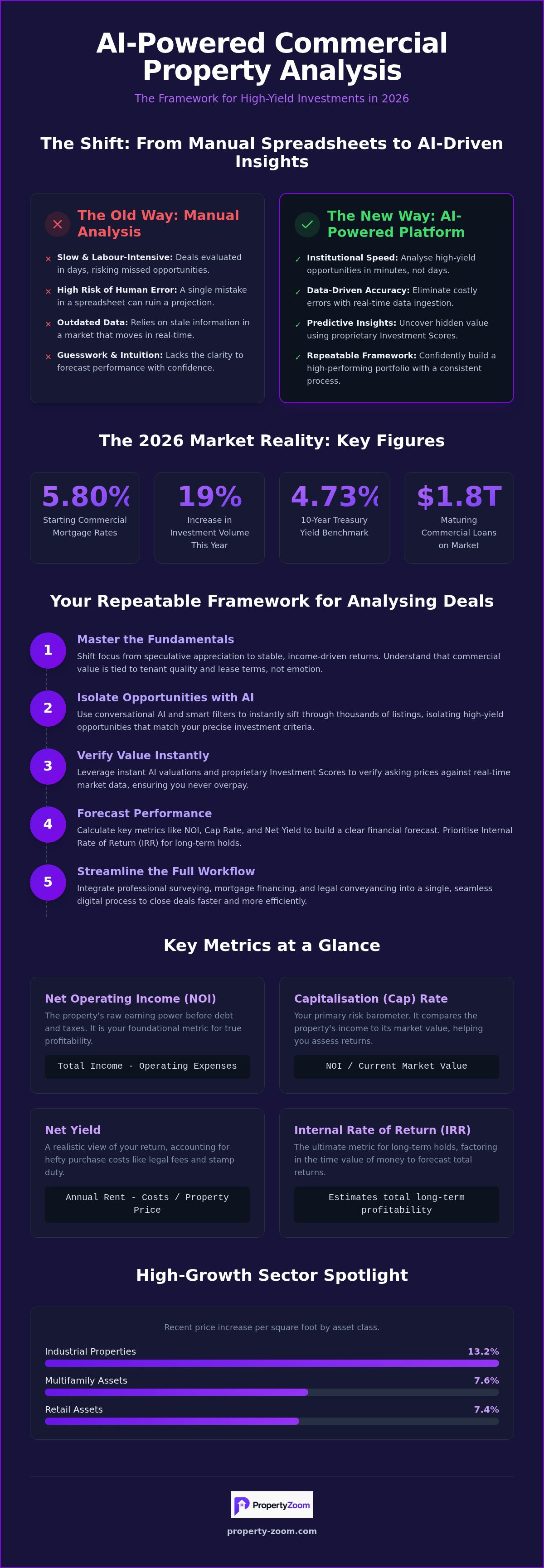
Step-by-Step Framework for Analysing Commercial Deals
Stop guessing and start executing. A robust commercial property investment analysis requires a linear workflow that replaces intuition with data. In a market where $1.8 trillion in commercial loans are maturing, the ability to filter, value, and stress-test a deal within minutes is your competitive edge. This framework moves you from a curious observer to a decisive investor by using technology to remove traditional barriers.
- Step 1: Define Criteria. Use conversational AI filters to isolate assets that match your risk profile, such as high-yield industrial units or land with specific planning potential.
- Step 2: Instant AI Valuation. Verify the asking price against real-time market data. With the median price per square foot for commercial properties sitting at $131 in Q2 2026, you must ensure the entry price aligns with local benchmarks.
- Step 3: Deep Dive into Metrics. Use automated calculators to process NOI and Cap Rates. This strips away the "manual slog" and provides an objective view of the asset's performance.
- Step 4: Conduct a Stress Test. Model your exit strategy against shifting variables. What happens to your yield if commercial mortgage rates, currently starting at 5.80%, rise toward the 9% mark?
- Step 5: Review the Score. Check the proprietary Investment Score and integrate professional surveyor insights to confirm the building's physical integrity.
Leveraging Conversational Search for Niche Assets
Basic filters often hide the best opportunities. Instead of scrolling through endless lists, you can ask PropertyZoom for "high-yield industrial units with upcoming lease renewals" or "undervalued land near new infrastructure hubs." This conversational approach allows you to find contractor stays and niche commercial hubs that others miss. It's about finding the "hidden" value amongst thousands of listings whilst saving hours of manual searching.
Final Due Diligence and Professional Referral
Once the AI confirms the numbers, you must transition to human expertise. This is where the journey becomes seamless. You can access our AI Valuations tool and then immediately organise your surveying and legal conveyancing through the same platform. This integration ensures that your final investment memorandum is backed by both predictive analytics and professional verification.
Organising your mortgage applications and legal work in one place keeps the momentum high. It prevents the deal from stalling in the final stages, which is critical when competing for high-demand assets like student accommodation. By the time you reach the settlement phase, you'll have a digital trail of every data point, providing total peace of mind for you and your stakeholders. This is how modern investors scale their portfolios with confidence and speed.
PropertyZoom: Transforming Commercial Analysis with AI
PropertyZoom isn't just a search platform; it is a comprehensive digital ecosystem designed for execution. It empowers you to perform commercial property investment analysis with the speed and precision of a global institution. You no longer need to wait days for manual reports or inconsistent data from multiple sources. Instead, you access instant AI valuations and proprietary scores that reflect the current market state. This efficiency is critical in a landscape where industrial property prices rose by 13.2% in Q2 2026. You need to move whilst the data is still fresh and the opportunity is live.
The platform removes the traditional barriers between finding a deal and closing it. By integrating mortgages, surveying, and legal conveyancing into a single workflow, we eliminate the friction that causes deals to collapse. With commercial mortgage rates currently ranging from 5.77% to 9.04%, having your financing and due diligence tools in one place is a massive strategic advantage. It ensures your commercial property investment analysis leads directly to a completed deal without the administrative delays that plague traditional methods. Data-driven investors choose this approach because it provides the clarity and momentum needed to scale quickly.
The Power of the Investment Score
Our proprietary algorithm removes the emotional bias that often leads to poor acquisitions. The Investment Score is the primary filter our top-tier investors use to grade and prioritise opportunities. It processes thousands of variables, including historical performance and predictive market shifts, to provide an objective grade. The score combines yield, growth, and risk into a single number. This allows you to compare a retail unit in the city centre against a suburban industrial site with total transparency. You'll know exactly which deals deserve your attention and which ones to skip.
Get Started with Smarter Analysis Today
You don't need to be a data scientist to use these tools. You can get started by running an AI valuation on any live listing to see if the asking price holds up against local benchmarks. This immediate reality check saves you from wasting time on overpriced assets. Accessing our full suite of commercial real estate data tools provides you with the same technological edge as institutional funds. It is a smarter, faster way to manage your investment journey from start to finish.
Ready to find your next deal? Explore our commercial property search engine.
Secure Your Competitive Edge in 2026
The landscape of commercial real estate has shifted permanently. Success in 2026 requires moving beyond the manual slog of the past. You've seen how mastering core metrics like NOI and Cap Rates provides the foundation, whilst AI-driven tools remove the risk of human error. By adopting a streamlined framework, you can evaluate complex deals with institutional speed and precision. Mastering your commercial property investment analysis is now a matter of leveraging the right technology to find hidden value in a volatile economy.
PropertyZoom provides everything you need in one place, from AI-powered Investment Scores and instant AI valuations to integrated surveying and legal services. This ecosystem is built to remove traditional barriers, making your journey from search to settlement feel effortless. It's time to move with confidence and leave the guesswork behind. Start your commercial property analysis with PropertyZoom today and secure high-yield deals before the competition even notices them. The future of property investment is smart, seamless, and ready for you to lead the way.
Frequently Asked Questions
What is the most important metric in commercial property investment analysis?
The foundation of any successful commercial property investment analysis is Net Operating Income (NOI). This metric represents the property's raw earning power by subtracting all operating expenses from the total revenue. It allows you to calculate the Capitalisation Rate, which serves as a primary risk barometer. Whilst appreciation is a bonus, professional investors in 2026 prioritise income-driven returns to ensure long-term stability in a high-interest rate environment.
How accurate are AI property valuations for commercial buildings?
AI valuations are exceptionally accurate because they ingest thousands of real-time data points that manual methods miss. PropertyZoom’s algorithms analyse local demand, recent transaction prices, and macro-economic shifts instantly. This removes the human error associated with outdated spreadsheets. Whilst no tool replaces final physical due diligence, AI provides a realistic, data-backed starting point that reflects current market volatility. It ensures you don't overpay for an asset in a fast-moving economy.
Can I use PropertyZoom for student accommodation and contractor stays?
Yes, PropertyZoom features specialised listings for both student accommodation and contractor stays. These niche high-yield sectors require specific data sets that traditional platforms often lack. Our conversational AI search tool allows you to isolate these opportunities by asking for specific criteria like "high-yield contractor stays near industrial hubs." This makes the platform a versatile scout for investors looking to diversify beyond traditional office or retail assets whilst maintaining institutional-grade data standards.
What is a good Cap Rate for a commercial property in the UK in 2026?
A "good" Cap Rate is relative to the asset class and location. In 2026, we've seen Cap Rate compression of 5 to 15 basis points across most property types. Prime industrial assets often command lower rates due to high demand, whilst secondary retail units might offer higher rates to compensate for increased risk. You should benchmark your target property against local market averages using our AI valuations to ensure the yield justifies the risk profile.
Do I still need a professional surveyor if I use AI analysis tools?
Yes, a professional surveyor remains a critical part of the final due diligence process. AI tools excel at financial modelling and market analysis, but they can't physically inspect a building's structural integrity. PropertyZoom integrates professional surveying services directly into the ecosystem. This allows you to transition seamlessly from a data-driven digital screening to a human-led physical inspection. It ensures your investment is structurally sound before you commit to any final purchase agreement.
How does conversational search help find commercial land deals?
Conversational search replaces rigid filters with natural language queries. You can ask PropertyZoom for specific opportunities, such as "undervalued land with planning potential near new transport links." This technology scans niche listings and identifies deals that don't fit into traditional categories. It saves hours of manual searching by surfacing relevant land deals instantly. This allows you to act on opportunities before they become visible to the wider market, giving you a competitive edge.
What are the risks of relying solely on manual spreadsheets for CRE analysis?
The primary risks include human error and the use of stagnant data. A single incorrect formula can ruin your commercial property investment analysis, leading to a poor acquisition. Manual spreadsheets also fail to account for real-time market shifts, such as fluctuating interest rates or local demand spikes. In 2026, relying on static tools is a liability that can result in missed opportunities or significantly underestimated operating costs that eat into your profit.
How do I calculate the Net Operating Income (NOI) for a multi-tenant building?
To calculate NOI for a multi-tenant building, sum all revenue streams including base rents, parking fees, and service charges. Then, subtract all necessary operating expenses such as insurance, property taxes, and maintenance costs. Don't include mortgage payments or income taxes in this calculation. This figure provides the raw income generated by the asset. It is essential for determining the property's value and overall investment score within our platform's analysis tools.


