

Why are you still squinting at rows of data when an algorithm can process 800 data signals in under 30 seconds? In 2026, relying on gut feeling or manual spreadsheets isn't just slow; it's a financial liability that prevents you from accurately calculating real estate investment scores. You've likely felt the frustration of staring at a deal that looks perfect on paper whilst worrying about the hidden risks lurking beneath the surface. It's exhausting to manually compare residential yield against capital growth potential, especially when the market moves this fast.
You deserve a smarter way to work. This guide shows you how to leverage AI-powered metrics to identify high-yield opportunities with institutional-grade precision. By moving beyond manual analysis, you'll gain access to a clear 1-10 ranking of property potential that slashes your initial due diligence time. We'll explore how these insights help you mitigate risk and provide the clarity you need to move forward with absolute confidence. From instant valuations to Zeba Calls AI efficiency, discover how to transform your investment strategy into a streamlined, results-oriented machine.
Key Takeaways
- Understand how AI synthesises hundreds of live data signals to replace outdated "gut feeling" strategies with objective property rankings.
- Learn the specific weighting factors, such as rental demand versus capital growth, that define high-performing real estate investment scores in 2026.
- Master the 1-10 ranking framework to identify high-yield opportunities and recognise when "middle-tier" properties offer unique situational value.
- Discover how to use conversational AI to filter listings and move from initial search to legal completion with institutional-grade speed.
- Leverage the integrated PropertyZoom ecosystem to transform instant valuations into actionable assets whilst minimising traditional investment risks.
Beyond the Yield: Why Real Estate Investment Scores Matter in 2026
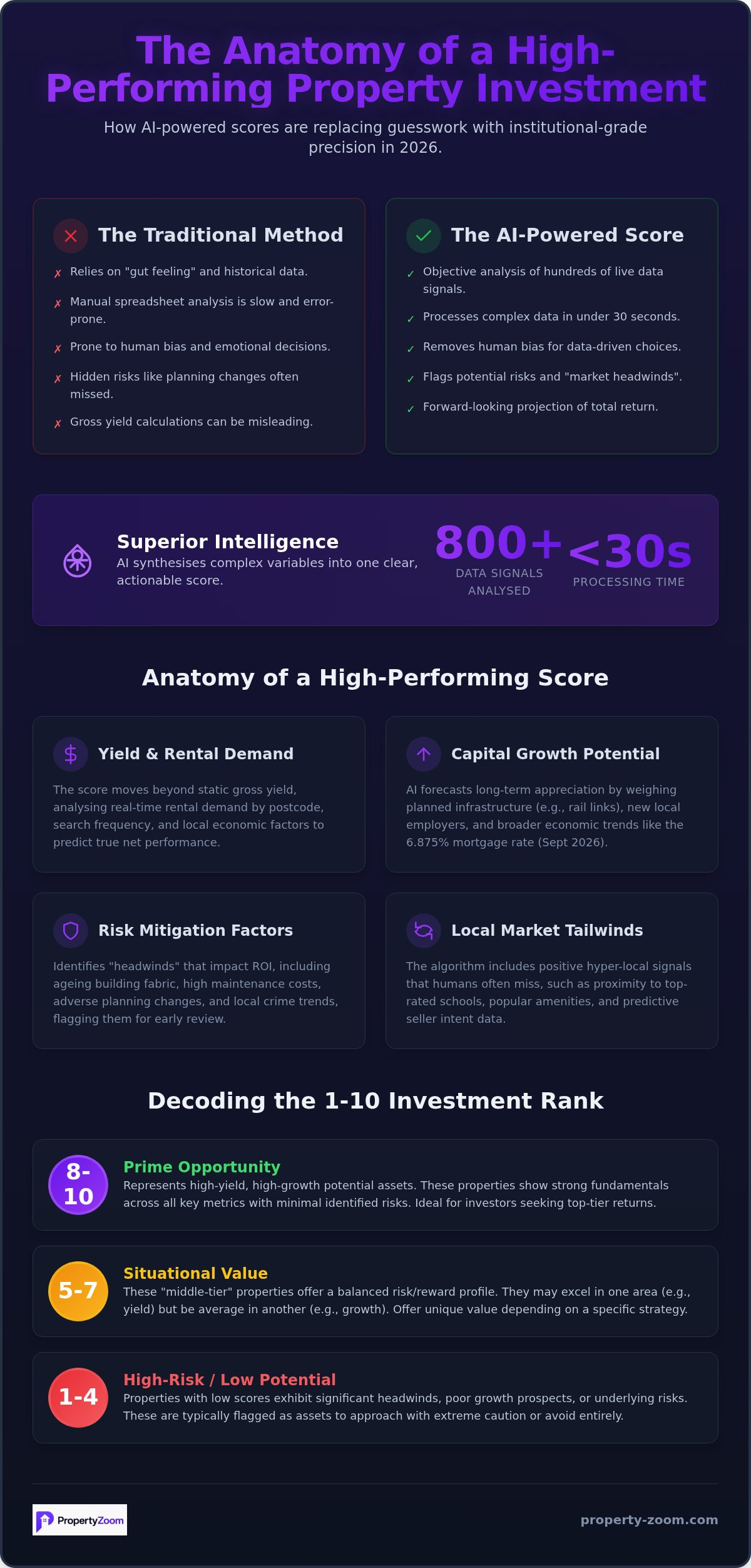
Success in the 2026 property market requires more than just capital; it requires superior intelligence. Traditional methods are simply too slow for a world where AI can process 800 signals in under 30 seconds. Real estate investment scores provide a multi-factor numerical representation of a property’s potential ROI, condensing market volatility into a manageable and actionable figure. This evolution from "gut feeling" to data-driven PropTech strategies allows you to organise your portfolio by risk profile whilst saving hundreds of hours on manual research. An investment score is a synthesis of yield, capital growth, and local market tailwinds. It acts as your high-tech assistant, removing traditional barriers to entry and providing the clarity needed to scale quickly.
The Limitations of Traditional Yield Calculations
Gross yield is a blunt instrument that often masks the true cost of an asset. It tells you what a property might earn but stays silent on what it will actually cost to maintain. By 2026, relying on historical data has become a significant risk because market conditions fluctuate with unprecedented speed. A property might look like a bargain on a spreadsheet, but a low investment score could highlight "hidden" variables like pending local planning changes, escalating service charges, or shifting tax trajectories. Modern scores refine the traditional property valuation process by adding predictive layers. This ensures you're looking at the net reality of a deal rather than a polished gross promise, protecting your capital from unforeseen liabilities.
Removing Human Bias from Property Selection
Human bias is one of the biggest threats to a healthy ROI. Investors often fall in love with a property's character whilst ignoring its poor long-term growth trajectory. AI doesn't have a "favourite" architectural style; it only cares about performance metrics. It identifies lucrative patterns amongst thousands of listings that human agents often overlook, such as predictive seller intent signals or hyper-local crime trends. This technological confidence empowers you to make bold decisions that others are too hesitant to take. Using tools like Zeba Calls AI also ensures that agent-related efficiency is maximised, focusing interactions on data rather than charm. Transparency in these scores leads to faster transaction cycles and a more professional, approachable investment experience for everyone involved.
The Anatomy of a High-Performing Property Score
A high-performing score is far more complex than a standard valuation. Whilst a valuation provides a snapshot of current market price, real estate investment scores offer a forward-looking projection of total return. The algorithm synthesises current rental demand with long-term capital appreciation potential. It weighs these factors differently based on your specific strategy. For instance, a property near a new rail link might receive a higher weighting for capital growth, even if the immediate yield is modest. The integration of AI in real estate allows these calculations to happen instantly; it factors in proximity to amenities, school catchments, and planned infrastructure projects that human analysis might miss.
Yield and Capital Growth Metrics
In 2026, yield is no longer a static number. The score predicts rental performance by analysing real-time demand data, such as search frequency for specific postcodes. This is especially vital for niche sectors like student housing or commercial land. Regional economic trends play a massive role in forecasting capital growth. If a major employer announces a new headquarters nearby, the algorithm adjusts the score immediately. We also account for the broader economic climate. With the 30-year fixed mortgage rate sitting at 6.875% as of September 2026, the score helps you determine if the projected growth outpaces the cost of debt. You can quickly see which properties offer the best AI-driven investment scores to match your financial goals.
Risk Mitigation and Confidence Flags
A smart score doesn't just highlight the positives; it flags the "headwinds" that could derail your ROI. It looks for ageing building fabric or high maintenance costs that eat into your profits. By incorporating surveying data early in the process, the algorithm identifies structural concerns before you spend money on a physical inspection. This reduces the fear of missing a hidden risk in a property that looks good on the surface. Alongside the 1-10 rank, you'll see a "confidence score". This tells you how much reliable data supports the investment grade. High confidence means the score is backed by deep, verified datasets; this gives you the peace of mind to move forward with a transaction without hesitation.
Decoding the Numbers: How to Evaluate Investment Rank Bands
Interpreting the numerical output of real estate investment scores requires a shift in perspective. A score isn't a simple "pass" or "fail" mark; it represents a risk-adjusted roadmap for your capital. By 2026, the median price of an existing home has reached $434,100, making the cost of a mistake higher than ever. These bands organise properties based on their alignment with current market tailwinds and institutional-grade metrics, allowing you to filter through thousands of listings in seconds.
Rank 8-10: The Institutional-Grade Opportunity
Properties in this band represent a rare alignment of competitive pricing, high local demand, and minimal carrying costs. These assets are often "Strong Setups" that institutional investors target for immediate acquisition. Because they offer the highest certainty of ROI, they frequently sell before hitting traditional portals, whilst PropertyZoom users gain a significant advantage by setting automated alerts for these top-tier scores. This allows you to move with the speed of a professional fund and bypass the noise of the open market.
Rank 5-7: The Balanced Portfolio Builder
A "middle" score is often the backbone of a stable portfolio. These properties aren't flawed; they simply involve calculated trade-offs. For instance, a property might have an exceptional location but a higher purchase price, which slightly dampens the immediate yield. You can use these scores as a powerful negotiation tool. If the AI identifies a score of 6 due to specific local "headwinds," you have the data to justify a lower offer. These rankings are particularly useful for niche sectors like student accommodation listings, where situational demand can fluctuate based on university intake patterns. This data-driven approach aligns with broader market analysis, such as Harvard's State of the Nation's Housing report, which highlights the importance of affordability and supply trends in investment selection.
Rank 1-4: Identifying High-Risk or Distressed Assets
Low scores usually signal significant obstacles, but for specialists, they represent opportunity. A score of 3 might flag a "fixer-upper" with structural issues or a property on land with complex development hurdles. Developers use these low real estate investment scores to identify undervalued land where the potential upside justifies the risk. Agents also rely on these numbers to manage client expectations. If a seller's price doesn't match the AI-calculated risk profile, the score provides an objective reality check that facilitates more honest conversations about market value.
From Data to Deal: Using Scores to Streamline Your Acquisition
The transition from browsing to buying is where most investors lose momentum. In 2026, real estate investment scores act as the bridge between raw data and a completed transaction. You can now use conversational AI to filter thousands of listings instantly. Simply ask your high-tech assistant to find properties with a score above 8 to bypass irrelevant options. This moves you from a passive observer to an active negotiator with institutional-grade precision. It removes the stress of the initial search and gives you the technological confidence to move forward without second-guessing your strategy.
Step 1: Intelligent Search and Shortlisting
Finding the right asset starts with AI property search platforms. These tools allow you to compare multiple properties side-by-side using standardised scores rather than subjective photos. You should organise your shortlist based on ROI potential and risk mitigation factors. This ensures your capital is deployed where it has the highest growth trajectory. By focusing on the numbers first, you avoid the emotional bias that often leads to overpaying for aesthetic appeal whilst ignoring structural headwinds. This methodical approach creates a sense of momentum, allowing you to shortlist ten properties in the time it used to take to analyse one.
Step 2: Validation via Professional Services
Professional services are no longer a bottleneck in your workflow. These scores inform the instruction of surveyors and legal conveyancers by highlighting specific risk signals early. If a score is slightly lower due to hyper-local crime trends or environmental factors, your surveyor knows exactly where to focus their physical inspection. This data-driven insight also assists with the federal reporting requirements for residential transfers that came into effect on March 1, 2026. It ensures your legal team has the transparency needed for a seamless "searches" phase, reducing the risk of deals falling through at the last minute.
Mortgage approvals also move faster in this ecosystem. Integrating your applications with AI valuations provides lenders with instant, accurate data. With the 30-year fixed mortgage rate at 6.875% as of September 2026, speed is essential for securing your rate before the market shifts. Using Zeba Calls AI further streamlines the process by ensuring agent communication is efficient and results-oriented. You can start your journey today by accessing the AI investment tools at PropertyZoom.
PropertyZoom: Transforming Investment Scores into Actionable Assets
PropertyZoom stands as the ultimate high-tech assistant for the 2026 investor. By combining ZEBA AI search with real-time real estate investment scores, the platform removes the traditional friction of property acquisition. You no longer need to jump between disparate tools to validate a deal. Instead, you access a streamlined workflow where data-driven insights lead directly to action. Our conversational AI allows you to filter for high-scoring properties using natural language, making the search process feel effortless. This synergy allows you to identify high-yield opportunities amongst thousands of listings, including specialised sectors like student accommodation listings and commercial land, with total precision.
The PropertyZoom Ecosystem Advantage
Efficiency is the core of our platform. We provide a seamless integration of search, valuation, and transaction services that removes the obstacles typically slowing down property deals. By housing legal conveyancing, surveying, and mortgage services in one smart hub, we ensure that your investment journey is methodical and quick. This ecosystem approach means that when you find a property with a top-tier rank, you can instruct professionals immediately. With the AI in real estate market projected to reach $405 billion in 2026, staying ahead requires this level of technological confidence. There is no fluff; every feature serves to move you forward, providing the relief and clarity you need to scale your portfolio effortlessly.
Empowering Agents with AI Tools
Modern agents must be data-driven experts to survive in the 2026 market. PropertyZoom empowers them with Zeba Calls AI, ensuring that no high-value investor lead is ever missed whilst the agent is off-site. This tool handles initial enquiries with sophisticated intelligence, filtering for serious buyers who prioritise real estate investment scores. Agents can also use our AI to generate precise listing descriptions that highlight these scores, instantly communicating value to professional stakeholders. It's about making the entire industry smarter and more transparent. This technology turns every agent into a reliable guide, capable of delivering institutional-grade insights to every client they serve.
Master the Market with AI-Driven Intelligence
The 2026 property market moves too fast for manual spreadsheets or guesswork. You've seen how real estate investment scores transform complex data into a clear roadmap for ROI, allowing you to bypass hidden risks and focus on high-yield opportunities. By synthesising yield, capital growth, and hyper-local tailwinds, these metrics provide the institutional-grade precision you need to scale your portfolio with absolute confidence. You can now move from initial search to legal completion within a single, integrated ecosystem that removes traditional barriers and slashes due diligence time.
PropertyZoom provides the ultimate high-tech assistant for this journey. Powered by ZEBA AI, our platform delivers instant investment scores whilst offering integrated legal, surveying, and mortgage services to streamline your transaction. It's time to replace outdated manual analysis with technological confidence and reclaim your peace of mind. The tools you need to identify the best assets amongst thousands of listings are now at your fingertips. Every feature is designed to move you forward, ensuring you never miss a lucrative deal due to slow processing.
Start your smarter property search on PropertyZoom and secure your next high-performing asset with precision.
Frequently Asked Questions
What is a good real estate investment score?
A good score typically falls between 8 and 10 on our standardised 1-10 scale. These "Strong Setup" properties represent a rare alignment of competitive pricing, high rental demand, and low carrying costs. However, a score of 5-7 is also considered solid for balanced portfolio building. It suggests the property has strong fundamentals but might involve specific trade-offs, such as a higher entry price or moderate maintenance requirements.
How accurate are AI-driven property investment scores in 2026?
AI accuracy has reached unprecedented levels in 2026, with modern platforms analysing over 800 data signals in under 30 seconds. By synthesising live market data, rental demand, and macroeconomic trends, these real estate investment scores provide a far more precise outlook than traditional manual analysis. Whilst no algorithm can predict every outlier, the use of institutional-grade data ensures that the risk-map provided is both reliable and actionable for serious investors.
Can a property with a low score still be a good investment?
Yes, a low score of 1-4 often signals a "fixer-upper" or a distressed asset that may appeal to specialist developers. These properties usually have significant hurdles, such as structural issues or complex land disputes, which lower the immediate score. For an investor with the expertise to resolve these "headwinds," a low-scoring property can offer substantial upside potential once the underlying problems are addressed and the asset is successfully repositioned.
How often are the investment scores updated on PropertyZoom?
PropertyZoom updates its investment scores in real-time as new data enters the ZEBA AI ecosystem. This includes live market signals, changes in interest rates, and updated rental demand metrics. Because the 2026 market fluctuates rapidly, our platform ensures you're always viewing the most current data. This constant refreshing allows you to make decisions with technological confidence, knowing that your analysis reflects today's legal and financial reality rather than last month's statistics.
What is the difference between a yield calculator and an investment score?
A yield calculator is a static tool that only measures the relationship between rent and purchase price. In contrast, an investment score is a multi-factor synthesis of yield, capital growth, and risk. It accounts for "hidden" variables like local planning changes, hyper-local crime trends, and property tax trajectory modelling. Whilst a calculator gives you a snapshot, a score provides a comprehensive risk-adjusted roadmap for your capital and total return potential.
Do investment scores take into account local planning permissions?
Yes, our AI-driven scores factor in local planning permissions and infrastructure projects as part of the capital growth forecasting. The algorithm identifies patterns in council approvals and major development announcements that could impact property values. By including these signals, the score helps you identify "tailwinds" that might boost a property's future ROI. This level of detail ensures your due diligence is thorough without requiring hundreds of hours of manual research.
Are these scores suitable for first-time property investors?
These scores are exceptionally helpful for first-time investors because they remove the reliance on "gut feeling" and intuition. By providing a clear 1-10 ranking, the platform acts as a high-tech assistant that simplifies complex data. It reduces the stress of a first purchase by highlighting potential risks and clarifying the expected ROI. This transparency empowers newcomers to move forward with the same confidence as institutional-grade professional stakeholders and fund managers.
How do investment scores help with securing a mortgage?
Investment scores streamline the mortgage process by providing lenders with data-driven evidence of a property's performance potential. When you integrate your application with our AI valuations, you present a professional, risk-adjusted case for lending. With the 30-year fixed mortgage rate at 6.875% as of September 2026, speed is vital. High scores give lenders confidence in the asset's health, which can lead to faster approvals and more seamless transaction cycles.


