

Could a 31% drop in study visa issuances actually be the best signal to double down on your student accommodation investment? While headlines focus on falling international numbers, savvy investors are looking at the £84.8 billion operational market value and seeing a different story. You're likely tired of high management fees eating your profits and the constant worry that new HMO licensing regulations will shift the goalposts overnight. It's difficult to predict true rental yields when the Renters' Rights Act 2025 has fundamentally changed the tenancy landscape.
This guide promises to help you master these 2026 complexities. You'll learn how to use AI-driven insights to identify high-yield university towns and secure low-risk assets that outperform the 3.75% base rate. We'll break down the widening ROI gap between Purpose-Built Student Accommodation (PBSA) and traditional HMOs whilst showing you how to automate your search and lead capture process. It’s time to replace manual spreadsheet guesswork with precise, data-backed performance metrics that ensure your capital works harder.
Key Takeaways
- Analyse the 2026 demographic shifts to understand why student housing remains a resilient, counter-cyclical asset class despite changing visa trends.
- Compare the ROI potential and regulatory risks of Purpose-Built Student Accommodation (PBSA) versus traditional HMO models under the Renters' Rights Act 2025.
- Master the use of AI-driven Investment Scores to evaluate over 20 distinct data points instantly for every potential student accommodation investment.
- Streamline your acquisition process by aligning specialised property surveys and legal conveyancing with the latest 2026 mortgage criteria.
- Leverage conversational AI search and automated lead management tools to identify and secure lucrative off-market deals with minimal manual effort.
The Resilience of Student Accommodation Investment in 2026
The UK's student housing market has entered a sophisticated new phase. With the operational PBSA market now valued at £84.8 billion in 2026, the sector is proving its mettle as a high-performing alternative to traditional residential lets. While some headlines focus on the 11% drop in visa applications seen in July 2026, the underlying reality for a student accommodation investment is one of structural undersupply and consistent demand. Education remains a priority for both domestic and international families, making this a classic counter-cyclical asset. When the wider economy fluctuates, people often return to university to upskill, ensuring a steady stream of tenants regardless of the financial climate.
Modern investors are moving away from the dilapidated digs of the past. Today's market is driven by premium, experience-led living. To understand what is student accommodation in the current era, one must look at high-spec studios and ensuite clusters that offer more than just a bed. These assets are shaping regional yield hotspots, particularly in cities where universities are expanding their post-graduate and mature student intake. International mobility continues to play a role, but the shift towards high-quality, professionally managed spaces is the real driver of capital growth in 2026.
Why Demand Outstrips Supply in University Cities
Identifying undersupplied towns requires more than a map; it needs real-time market data. Many university cities face a chronic shortage of beds as institutions expand their campuses but fail to build enough halls. This gap creates a massive opportunity for private investors to fill the void. In 2026, we're seeing record numbers of mature students who demand higher standards and are willing to pay a premium for quiet, well-located housing. This demographic isn't just looking for a room. They're looking for a professional environment that supports their studies, which keeps occupancy rates high and voids low.
Yield Performance vs Standard Buy-to-Let
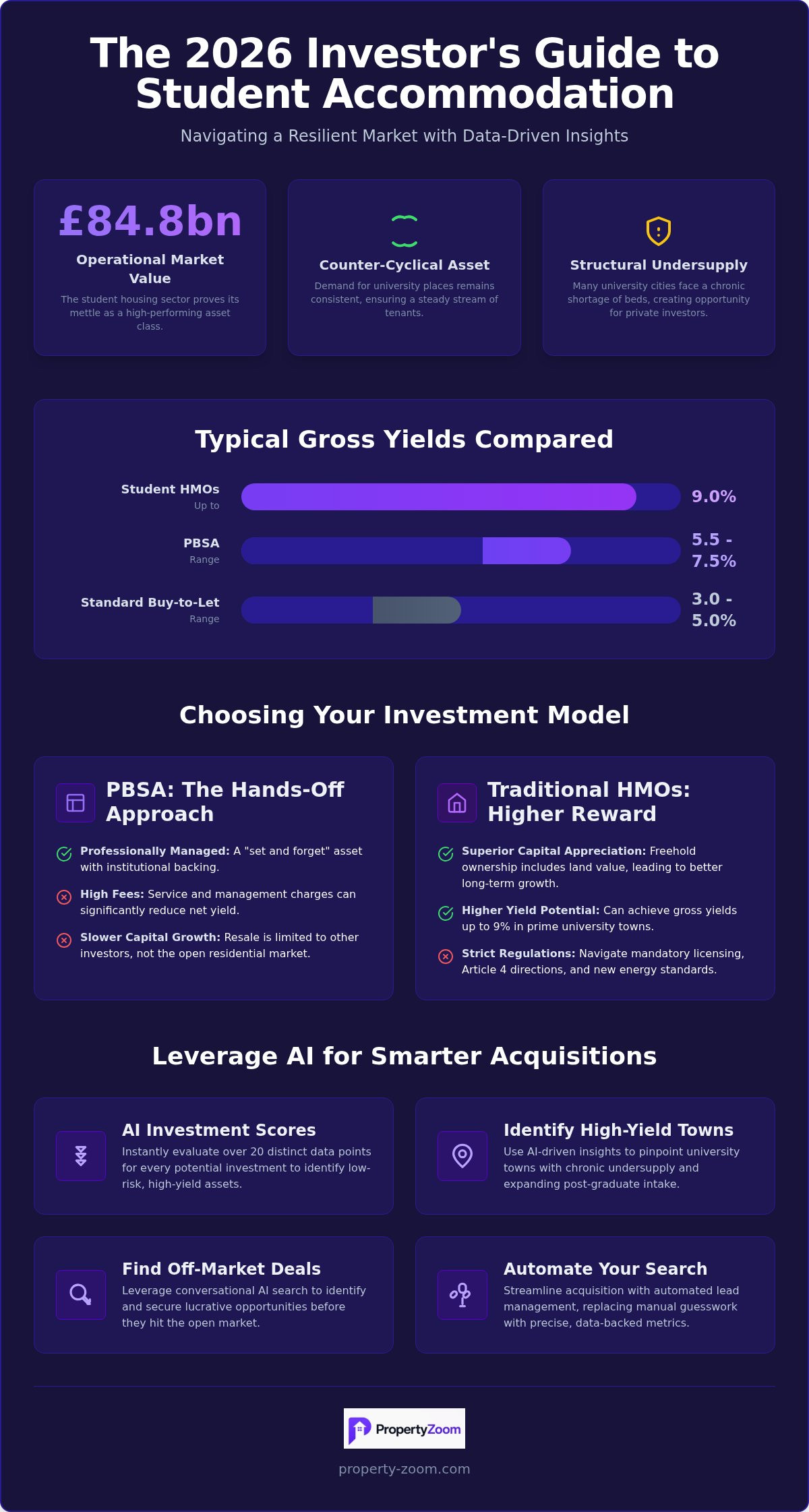
The numbers tell a compelling story for anyone considering a student accommodation investment. Gross yields for student lets typically range between 6% and 9%, significantly outperforming the 3% to 5% often seen in standard residential buy-to-lets. While PBSA yields sit comfortably between 5.5% and 7.5%, traditional HMOs in university towns can still achieve up to 9%. This recession-proof performance is linked to the fixed nature of academic years and the guarantee of rental income. In 2026, student yields typically outperform residential HMOs because the concentration of multiple tenants in a single property allows for higher per-room rates whilst maintaining lower vacancy risks during term time.
PBSA vs HMOs: Choosing Your Investment Model
Deciding on the right vehicle for your student accommodation investment depends on your appetite for management and capital risk. In 2026, the market is clearly divided between institutional-grade Purpose-Built Student Accommodation (PBSA) and traditional Houses in Multiple Occupation (HMO). Each model offers a distinct pathway to growth, but they require different strategies to navigate a tightening regulatory environment. Whilst PBSA offers a hands-off experience, HMOs provide the flexibility of freehold ownership and land value.
PBSA: The Hands-Off Institutional Approach
Institutional PBSA is frequently marketed as a "set and forget" asset. You typically purchase a "pod" or a single studio within a large, professionally managed block. The 2026 student housing outlook suggests that while occupancy remains high, investors must be wary of resale limitations. Because these units are restricted to student use and sold to other investors rather than residential buyers, capital growth can be slower than traditional housing. High service charges and management fees are often the hidden yield killers here, sometimes consuming a significant portion of gross income. However, for those seeking passive wealth, the institutional backing provides a layer of security that smaller landlords often lack in a volatile market.
Traditional HMOs: Higher Effort, Higher Reward
Traditional HMOs offer a different value proposition. You own the freehold and the underlying land, which usually leads to superior long-term capital appreciation. The challenge in 2026 is meeting new energy efficiency standards and navigating strict licensing. Mandatory licensing applies to properties with five or more occupants, whilst over 70 local councils have introduced additional schemes for smaller units. Article 4 directions are also more common, removing permitted development rights and making it harder to convert family homes into new student lets. You can use an AI property search platform to find unmodernised HMO gems that haven't hit the open market yet. These properties allow you to add value through refurbishment, essentially "manufacturing" equity by modernising older stock to meet 2026 standards.
Successful investors often balance their portfolio by mixing both types to hedge against local policy changes. If you want to see how a specific property stacks up against current market averages, you can check its potential using AI Valuations to ensure the numbers align with your financial goals. This data-driven approach removes the guesswork, allowing you to focus on assets with the highest performance potential.
Using AI Investment Scores to Evaluate Risk
Successful property acquisition in 2026 requires moving beyond "gut feeling" and local hearsay. The traditional method of manual spreadsheet analysis is too slow for today's fast-moving market. Instead, smart investors rely on Investment Scores to filter noise from actual value. An Investment Score is a metric of total return potential, calculated by an AI that cross-references over 20 distinct data points for every listing. This allows you to assess a student accommodation investment with surgical precision before you even book a viewing.
These scores aren't just about the rental figure on the page. They integrate vital local context, such as proximity to campus, crime rates, and transport links. PropertyZoom's algorithm evaluates the "micro-location" of a property, ensuring that a high yield isn't just a "yield trap" caused by a low purchase price in a declining area. By aggregating data on local amenities and student footfall, the AI identifies properties that will remain in high demand even if the wider market fluctuates.
Predictive Yield Modelling for 2026
Predicting future returns is no longer a guessing game. AI models now analyse historical university enrolment data to forecast rental growth with high accuracy. For instance, whilst study visa issuances dropped by 31% in early 2026, certain regional hubs continue to see a surge in domestic post-graduate applications. Data identifies properties with year-round appeal, helping you factor in potential voids. By looking at the supply-demand balance in specific postcodes, the technology predicts where rents are likely to climb, ensuring your capital is positioned for maximum growth.
Risk Mitigation through Data Analysis
One of the biggest risks in the student sector is over-saturation. AI helps you spot postcodes where too many new PBSA blocks are currently under construction, which could dilute your future tenant pool. By analysing local planning applications, the system predicts future competition before it hits the market. This level of foresight is crucial for your exit strategy. Whether you plan to sell to another investor or flip the property back to the residential market, data-driven insights ensure you aren't left holding an asset in a saturated or declining neighbourhood. This proactive approach turns a complex process into a streamlined, low-risk journey.
The Buying Journey: Legal, Surveying, and Finance
The transition from finding a deal to closing it is where many investors lose momentum. In 2026, the 3.75% Bank of England base rate has stabilised the market, but lenders remain cautious. Securing a student accommodation investment requires a clear financial strategy and a robust legal framework. You need to align your finance, surveying, and conveyancing teams early to avoid delays that could cost you the deal. A streamlined approach ensures you move from offer to completion with maximum efficiency.
Securing the Right Mortgage for Student Housing
Lenders view HMOs and self-contained studios differently. For HMOs, they focus on your management experience and the local licensing environment. For studios, the focus shifts to the management company and the block's track record. With the 3.75% base rate held steady as of July 2026, you can now find more competitive commercial products. Using AI Valuations helps you provide lenders with accurate, data-backed figures instantly. This transparency builds trust and can significantly reduce the time spent in the underwriting phase. You should prepare for stricter stress-testing, as lenders now look closely at your ability to cover higher maintenance costs and HMO licensing fees.
Surveying and Legal Due Diligence
A standard residential survey isn't enough for the student sector. You need a specialised professional who understands fire safety regulations and EPC requirements. The Renters' Rights Act 2025 has increased the scrutiny on property standards, making thorough due diligence non-negotiable. Legal conveyancing for multi-unit blocks often involves complex titles and leasehold agreements that require expert handling. PropertyZoom manages this transaction tail by connecting you with a vetted network of professionals. This integration ensures that your legal and surveying teams are already familiar with the specific requirements of student assets, from checking Article 4 compliance to verifying HMO licenses.
Backup Strategies for Voids
Even with the best data, academic cycles can leave gaps. A growing trend in 2026 is the use of "contractor stays" as a secondary income stream. If a room remains unlet after the main academic intake, marketing it to professional contractors provides a high-yield safety net. This flexibility ensures your cash flow remains positive whilst you wait for the next student cycle. It's a pragmatic way to hedge against the 31% drop in visa issuances seen earlier this year. Having a backup plan turns a potential vacancy into a profitable opportunity.
Ready to secure your next asset? Start your journey by exploring our Mortgages and Surveying services today.
Optimising Your Portfolio with PropertyZoom AI
Modern student accommodation investment isn't just about the purchase; it's about the tech stack you use to manage and grow your assets. PropertyZoom removes traditional barriers by replacing slow, manual processes with a streamlined digital ecosystem. Whilst competitors rely on traditional email updates and phone calls, our platform uses conversational AI search to find off-market deals before they reach the public portals. This gives you a significant advantage in the competitive 2026 landscape, where speed is the primary driver of success.
Tracking your portfolio's performance is equally effortless. Our AI Valuations provide real-time updates on your asset's worth, factoring in the latest market shifts and student demographic changes. This allows you to make informed decisions about when to refinance or divest, ensuring your capital is always working at its peak capacity. By integrating every stage of the journey into one platform, you gain the clarity needed to scale with confidence.
Efficient Lead Management for Landlords
Managing enquiries is often the most stressful part of property ownership. Zeba Calls AI changes this by handling student enquiries 24/7, answering questions and qualifying leads whilst you sleep. The system integrates directly with your calendar to organise viewings automatically, removing the back-and-forth of manual scheduling. By using AI-driven listing creation, you can reduce the cost of vacancy by getting properties back on the market instantly with optimised descriptions that appeal to the 2026 student demographic.
Future-Proofing Your Investment
Scaling your portfolio from a single pod to a multi-city operation requires a data-driven foundation. PropertyZoom provides the insights needed to stay ahead of market trends, such as the shift towards contractor stays or changes in HMO licensing. Our ecosystem acts as your "Smart Digital Scout," continuously monitoring the market for opportunities that match your Investment Score criteria. This approach transforms property management from a full-time job into a high-performance investment strategy that prioritises your peace of mind.
Start your AI-powered search for student accommodation today and experience a more intelligent way to grow your wealth.
Future-Proofing Your Student Property Portfolio
Success in 2026 requires a shift from traditional guesswork to a data-driven strategy. You've seen how structural undersupply and premium, experience-led living continue to drive the market. By choosing the right model between PBSA and HMOs, and using AI to filter for real value, you can navigate the Renters' Rights Act whilst maintaining high performance. The key is to act with precision, using performance metrics to secure assets that outperform the current base rate and provide long-term security.
PropertyZoom provides the tools to make this journey effortless. You can leverage AI-driven valuations and conversational property search to find deals that remain hidden from the open market. With integrated legal and mortgage referrals, the transition from discovery to ownership is seamless and transparent. Secure your position in this resilient asset class by making smarter, faster decisions that prioritise your peace of mind. The right student accommodation investment is waiting for you.
Ready to scale? Find your next high-yield student investment on PropertyZoom and take control of your financial future with confidence.
Frequently Asked Questions
Is student accommodation a good investment in 2026?
Yes, it remains a resilient asset class with an operational UK market value of £84.8 billion. Despite fluctuations in visa applications, structural undersupply in university towns keeps occupancy high. Yields for a student accommodation investment typically range from 6% to 9%, significantly outperforming standard buy-to-lets. It's a counter-cyclical asset that stays stable during economic shifts because education remains a top priority for both domestic and international students alike.
What is the difference between PBSA and an HMO?
PBSA refers to Purpose-Built Student Accommodation, which is institutional-grade housing like studio pods or cluster flats managed by professional companies. HMOs, or Houses in Multiple Occupation, are traditional residential properties converted to house three or more unrelated tenants. Whilst PBSA offers a hands-off experience, HMOs allow you to own the freehold and benefit from land value growth. HMOs often achieve higher yields but require more active management and stricter licensing compliance.
How much deposit do I need for a student property investment?
You'll typically need a deposit of 25% to 35% for a student property. Lenders view these as higher-risk commercial or specialist buy-to-let loans, so they require more equity than a standard residential mortgage. The exact amount depends on whether you're buying a traditional HMO or a PBSA unit. Having a larger deposit often helps you secure more competitive interest rates, which is crucial whilst the Bank of England base rate sits at 3.75% in 2026.
Can I get a mortgage for a student pod or studio?
Yes, but your options are more restricted compared to traditional houses. Many high-street lenders won't finance individual student pods, so you'll likely need a specialist commercial lender. They'll evaluate the track record of the management company and the block's occupancy rates. It's vital to have a robust valuation; using AI-driven insights can help you present a stronger case to lenders by proving the asset's total return potential and consistent tenant demand.
What are the main risks of student housing investment?
The primary risks include changing government visa policies, which can impact international student numbers, and evolving local regulations like Article 4 directions. Over-saturation in specific postcodes can also lead to higher void periods if too many new blocks open at once. You must also manage rising maintenance costs and strict HMO licensing fees. Using data-driven scoring helps you identify these risks early by spotting saturation and predicting future competition from new planning applications.
How do AI investment scores help me find better deals?
AI investment scores remove the guesswork by cross-referencing over 20 data points, including proximity to campus, transport links, and local amenities. This metric identifies high-yield opportunities whilst flagging "yield traps" where low prices hide poor growth potential. By aggregating historical enrolment data and real-time market trends, the scores provide a total return forecast. This allows you to compare listings instantly and focus your capital on assets with the lowest risk and highest performance.
What are the legal requirements for student lets in the UK?
You must comply with mandatory HMO licensing if the property has five or more occupants from different households. Local councils may also have additional licensing for smaller properties. Properties must meet strict fire safety standards, have a valid EPC rating, and provide minimum bedroom sizes. The Renters' Rights Act 2025 has also abolished fixed-term tenancies for most private landlords, making it essential to understand your new obligations regarding periodic tenancies and tenant protections.
How does Zeba Calls AI help property investors?
Zeba Calls AI automates your lead management by handling student enquiries 24/7. It answers common questions about your listings and qualifies potential tenants whilst you sleep. The system integrates with your calendar to book viewings automatically, removing the need for manual back-and-forth communication. This technology reduces vacancy costs by ensuring no lead is missed and allows you to manage a larger student accommodation investment portfolio with significantly less administrative effort and lower overheads.


