

Why are some investors scaling their portfolios with surgical precision whilst you are still drowning in dozens of open browser tabs? It’s a common frustration in 2026; traditional property portals offer plenty of listings but very little clarity. You might find yourself struggling to compare a high-yield opportunity in Indianapolis against a stable growth prospect in Columbus, all whilst worrying about the impact of the ROAD to Housing Act on your next move. This information overload often leads to a fear of overpaying in a market where interest rates for investment loans hover around 7.5%.
Mastering residential property investment scores is the solution to this complexity. These data-driven metrics act as a digital scout, filtering market noise into actionable signals. By learning how to interpret these scores, you can replace guesswork with a professional framework for evaluating deals. This article provides a clear roadmap to faster decision-making and total confidence in your yield and growth projections. We’ll examine how to use these intelligent tools to identify top-performing assets and scale your portfolio with modern efficiency. You will learn to navigate the 2026 market with the clarity of a seasoned expert.
Key Takeaways
- Understand how numerical scores remove the emotional bias and information overload common in traditional property searches.
- Learn to interpret residential property investment scores to accurately forecast both immediate rental income and five-year capital growth.
- Develop a clear framework for comparing high-yield "cash flow" assets against properties optimised for long-term equity build.
- Streamline your acquisition strategy by using AI-driven search filters that prioritise properties meeting your exact performance thresholds.
- Gain a competitive advantage by integrating instant AI valuations and real-time data insights into your daily investment workflow.
The Foundations of Residential Property Investment Scores
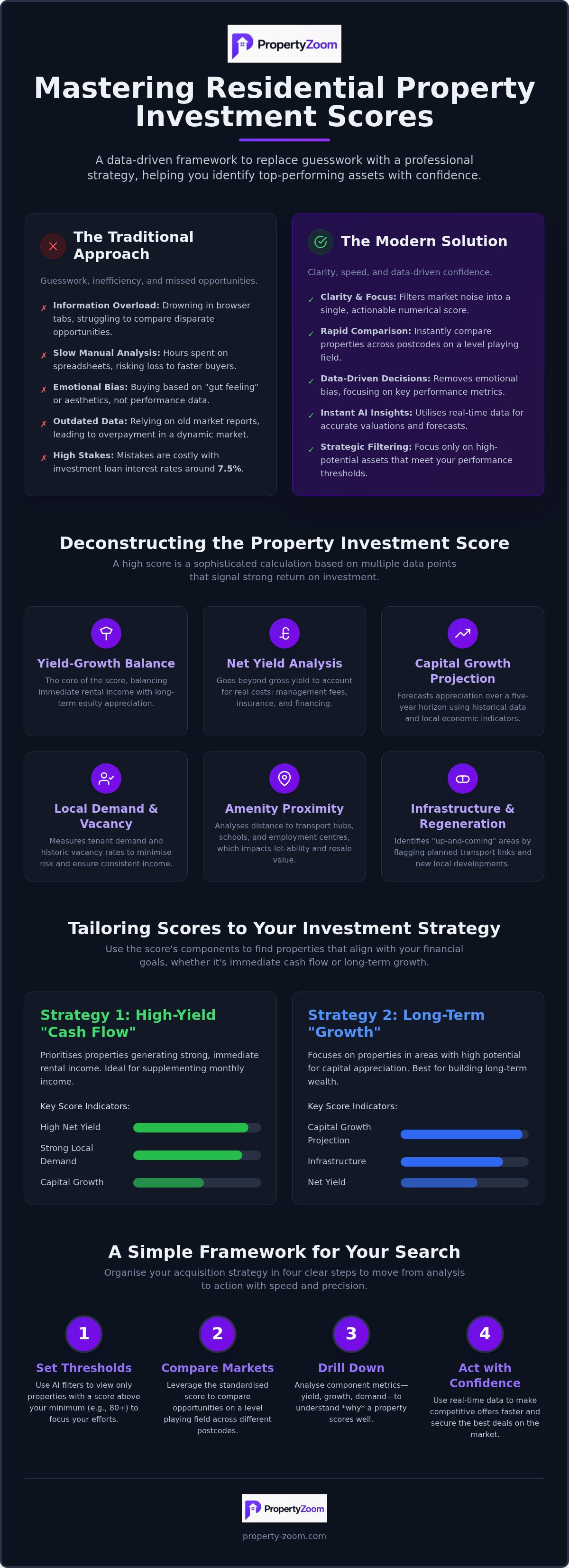
A residential property investment score is a numerical representation of a property’s potential return on investment (ROI). It isn't a guess; it's a sophisticated calculation based on multifaceted data points like local demand, historical growth, and current rental yields. In the volatile market of 2026, these scores act as a vital filter. They help you cut through the noise of hundreds of listings to find the gems. This data-driven approach mirrors the institutional Investment rating of a real estate property, but it's tailored for the speed of the modern residential market. By shifting from manual spreadsheets to real-time AI insights, you can identify your favourite leads in seconds rather than days.
The Problem with Traditional Manual Analysis
Relying on gut feeling is a dangerous strategy for capital allocation. Many investors fall into the trap of buying a property because they "like the look of it," only to find the numbers don't stack up later. Manual analysis is also incredibly slow. Calculating yields, researching local trends, and checking comparables for every listing takes hours. By the time you've finished your spreadsheet, a more efficient buyer has already made an offer. Outdated data can also colour your perception. If you're using six-month-old market reports, you might overpay for an asset that's already peaked. In a market where interest rates for investment loans are around 7.5%, there's no room for such inefficiencies. You need a system that organises information instantly.
How Scores Simplify the Decision-Making Process
Applying residential property investment scores provides a standardised benchmark for your entire search. It allows you to compare properties across different postcodes on a level playing field. You can instantly see how a high-yield flat in Manchester stacks up against a capital-growth prospect in Birmingham. This system effectively removes emotional bias. You stop looking at the wallpaper and start looking at the performance metrics.
Using residential property investment scores also allows for rapid filtering. You can set a rule to only view properties with a score of 80 or above. This focus ensures you only spend time on high-potential opportunities. It turns a chaotic search into a streamlined digital workflow. You gain the clarity needed to move fast, which is the only way to scale a portfolio effectively in 2026. Efficiency isn't just a bonus; it's a requirement for success amongst today's professional investors.
Deconstructing the Score: Metrics that Matter Amongst Investors
Most traditional platforms provide city-wide data, but professional residential property investment scores drill down into the performance of specific assets. This granular logic is what separates a generic search from a professional acquisition strategy. The Yield-Growth Balance is the core of a high score, representing the delicate equilibrium between immediate cash flow and long-term equity appreciation. To scale efficiently, you must look beyond the headline price and understand the components that drive these numerical ratings.
Gross yield is a starting point, but net yield tells the true story. A high score accounts for management fees, insurance, and the financing costs associated with the current 7.5% interest rates for investment loans. It also projects capital growth over a five-year horizon, using historical trends and local economic indicators. A property might look cheap, but if it lacks a strong growth trajectory, its overall score will reflect that limitation. You can view these detailed metrics instantly by checking AI-driven investment scores for your target postcodes.
Local demand and vacancy rates are critical risk dampeners. An empty property has a yield of zero, so a high score requires proof of a stable tenant base. Amenity proximity also weights the final result. Distance to transport hubs, high-performing schools, and local employment centres directly affects a property's let-ability and future resale value. These factors aren't just "nice to have"; they are mathematical drivers of ROI.
The Role of Local Infrastructure and Regeneration
Data-driven signals identify "up-and-coming" areas before price growth becomes obvious to the general public. Planned transport links or new commercial developments boost a score whilst prices are still accessible. High local employment rates suggest residential stability, which is a key metric for investors seeking low-turnover tenancies. By tracking these regeneration signals, the score helps you enter a market at the optimal time.
Risk Assessment and Score Adjustments
A score isn't just about potential upside; it's about protecting your capital. Older residential buildings often receive score adjustments to account for higher maintenance costs and structural risks. EPC ratings are also vital in 2026. Properties with low energy efficiency may face future letting restrictions or require expensive retrofitting, which drags down the total score. Modern scoring systems also weight interest rate fluctuations, ensuring your projections remain realistic even if borrowing costs shift. This pragmatic approach ensures you don't just find a deal, but a sustainable asset for your portfolio.
Comparing High-Yield Opportunities and Long-Term Growth
Scaling a portfolio requires a sharp distinction between "Cash Flow" assets and "Equity Build" properties. Whilst high-yield properties provide the monthly liquidity needed to cover financing, equity-focused assets build the long-term wealth required for significant expansion. You might encounter a property in a market like Cleveland with a 9% gross yield that carries a surprisingly low overall score. This happens when the data identifies high vacancy rates, poor school catchments, or a stagnant local economy. It’s a vital reminder that residential property investment scores are multidimensional; they protect you from "yield traps" where high returns are offset by high risk.
Success in 2026 relies on identifying where these two paths intersect. High-growth markets like Columbus or Indianapolis currently offer a rare blend of stability and returns, with cap rates between 6% and 8%. Using an AI Property Search Platform: The Smarter Way to Find and Invest in 2026 allows you to filter for these sweet spots instantly. Instead of manually comparing postcodes, you can use real-time data to see which properties offer the best risk-adjusted returns based on your specific strategy.
Niche Markets: Student Accommodation and Contractor Stays
Specialised listings like student accommodation and contractor stays often carry higher residential property investment scores due to their intense income potential. These niche sectors can significantly outperform traditional buy-to-lets, though they require more active management. AI search tools identify these opportunities by analysing local demand signals that manual filters often miss. For example, a property near a major university or a large-scale infrastructure project might show a score boost before the general market reacts. You must manage the higher turnover associated with these short-term lets, but the data-driven insights ensure the yield justifies the effort.
Balancing Your Portfolio with Diverse Scores
You shouldn't only buy properties with the highest possible score. A resilient portfolio requires a mix of high-yield "engines" and stable "anchors." Mixing high-yield assets in the Midwest with capital growth homes in established hubs creates a balanced risk profile. Use your investment scores to rebalance your residential holdings annually. If a property’s score drops due to changing local dynamics, it may be time to exit and reallocate capital into a higher-scoring opportunity. This methodical approach ensures your portfolio remains efficient and aligned with the 2026 market reality.
How to Organise Your Search Using Investment Data
Traditional property searching is a reactive process. You wait for a portal alert, scroll through photos, and then scramble to run the numbers on a spreadsheet. Using residential property investment scores transforms this into a proactive, data-led workflow. By defining your parameters before you start, you eliminate 90% of market noise. This structured approach allows you to focus only on assets that meet your specific financial goals. Efficiency is the primary driver of portfolio scaling; you can't grow if you're stuck in a cycle of manual analysis for every listing.
The most effective way to manage this data is to cross-reference investment scores with instant AI valuations. This technique helps you spot underpriced gems where the market hasn't yet caught up to the property's true potential. Once you've identified these opportunities, you can organise a shortlist for physical viewing or further surveying. This ensures that every minute you spend "on the ground" is backed by solid performance metrics. You are no longer just looking for a house; you are acquiring a high-performance financial asset.
Step 1: Setting Your Thresholds
Start by determining your minimum acceptable metrics. For many investors in 2026, a score of 75/100 serves as the standard benchmark for further investigation. You can then filter by property type to match your specific strategy. If you prefer the stability of houses over the higher yields of flats, set your AI search to prioritise houses within your high-score range. Conversational AI search tools allow you to find deals that have an "off-market" feel by identifying properties that meet your criteria before they attract mass-market attention. You can start building your high-performance shortlist today by using PropertyZoom’s AI-powered search tools to filter the market by real-time investment potential.
Step 2: Validating the AI Insights
A high score is a powerful signal, but it requires validation. Review the automated property valuation report for any local discrepancies that might affect the final price. It's also vital to use digital property surveying to confirm the physical condition matches the data-driven projection. If a property requires significant structural repair, the real-world yield will quickly diverge from the initial score. Finally, consult with mortgage brokers early in the process. Ensure your financing aligns with the deal, especially since conventional loans for 2-4 unit properties often require a 25% down payment. This final check ensures that the residential property investment scores you're acting on are supported by a practical path to completion.
Leveraging PropertyZoom AI for Real-Time Investment Insights
PropertyZoom provides the technological edge needed to dominate the 2026 market. Traditional platforms rely on historical data that often lags behind real-world shifts by several months. In contrast, PropertyZoom’s AI valuations offer real-time insights. This allows you to act on current market conditions before your competitors even spot the trend. Having residential property investment scores directly integrated into your search interface means you don't have to switch between tabs. You see the performance metrics alongside the listing. This makes the evaluation process instantaneous and highly reliable.
Embracing AI property search UK is the only way to maintain a competitive advantage this year. Manual searching is simply too slow for the pace of modern acquisitions. By using these residential property investment scores to guide your search, you remove the guesswork from your scaling strategy. This streamlined approach allows you to scale your portfolio with the precision of a high-tech assistant. It removes the traditional barriers that often stall growth. You gain clarity and speed, which are the two most valuable currencies in property investment today.
The Power of Conversational AI Search
Asking for exactly what you want is much more efficient than clicking through rigid drop-down menus. You can simply ask PropertyZoom for "high-yield student accommodation in Manchester" or "commercial listings with a minimum investment score of 80." Natural language queries understand the nuance of your request. They find better deals whilst others are still stuck on page one of a generic search. This speed advantage is critical for time-sensitive investors. You need to move on high-potential opportunities before they hit the mass market. Conversational search makes that possible.
A Seamless Ecosystem from Score to Completion
The journey doesn't end once you've found a high-scoring property. PropertyZoom integrates legal conveyancing, surveying, and mortgages directly into the platform. This creates a seamless transition from the initial search to final completion. For those managing multiple enquiries, Zeba Calls AI helps agents handle communications on your favourite listings. This ensures no detail is missed amongst the fast-paced nature of the deal. This integrated ecosystem removes the stress of coordinating multiple third-party services. You can start your journey today with a smart property buying assistant that handles the heavy lifting for you. This is the future of property acquisition: fast, intelligent, and entirely data-driven.
Future-Proof Your Property Acquisition Strategy
Scaling a portfolio in 2026 requires more than just capital; it requires the right data. You've seen how shifting from manual analysis to residential property investment scores removes emotional bias and identifies high-performance assets instantly. By balancing immediate cash flow with long-term capital growth, you can build a resilient portfolio whilst your competitors are still stuck in manual research. The days of drowning in browser tabs are over. You now have the framework to filter the market with surgical precision and act on opportunities before they reach the mainstream.
PropertyZoom provides the tools to make this transition effortless. Powered by ZEBA AI technology, the platform offers instant AI-driven valuations and a comprehensive ecosystem that includes legal conveyancing and mortgages. It's time to stop searching and start acquiring with total confidence. Discover high-yield deals with PropertyZoom Investment Scores and take the first step toward a smarter investment journey. Your next high-performance asset is only a search away.
Frequently Asked Questions
What is a good residential property investment score?
A strong score typically starts at 75 out of 100, though this depends on your specific strategy. If you focus on high-yield regions like the Midwest, you might target scores above 80. Conversely, properties in established capital growth hubs might carry a slightly lower yield score but a high total rating due to equity projections. You should define your personal threshold based on your risk tolerance before starting your search.
How accurate are AI property investment scores in 2026?
These scores are highly accurate because they utilise real-time data streams rather than lagging historical reports. Powered by ZEBA AI technology, the system analyses current demand, historical growth, and live rental listings to provide a precise outlook. Whilst no algorithm can predict black swan events, these scores offer a much higher degree of reliability than traditional manual calculations. They allow you to act on market shifts whilst others are reviewing outdated reports.
Do these scores take into account renovation costs?
Standard residential property investment scores typically reflect the property's current market state and potential based on its listing data. However, PropertyZoom’s system often applies adjustments for older residential buildings that may require higher maintenance. If you plan a significant renovation, you should factor those specific costs into your net yield calculations separately. The score provides the foundation, but your physical surveying will confirm the final feasibility of a project.
Can I rely solely on an investment score to buy a property?
You should use the score as a powerful filtering tool rather than a sole decision-making factor. It streamlines your search by highlighting high-potential assets, but physical surveying and legal conveyancing remain essential steps. The score identifies the mathematical opportunity, whilst professional inspections confirm the physical reality. Combining data-driven insights with traditional due diligence is the most effective way to scale your portfolio safely and efficiently in the 2026 market.
How often are property investment scores updated?
PropertyZoom updates its scores in real-time to reflect the latest market movements across the UK. This includes changes in local rental demand, updated sale prices in the area, and shifts in interest rates. Because the 2026 market moves quickly, having daily updates ensures your search is always based on the most current information available. This frequency prevents you from chasing deals that no longer meet your criteria or missing out on newly listed assets.
Are investment scores different for student accommodation vs standard residential?
Yes, the scoring logic for student accommodation differs significantly from standard residential homes. Student listings are weighted more heavily on proximity to university campuses and term-time occupancy rates. Standard residential scores focus more on long-term tenant stability and local school catchments. PropertyZoom’s specialised listings ensure that the residential property investment scores you see are tailored to the specific asset class, allowing for accurate comparisons within niche markets like student lets.
What is the difference between a valuation and an investment score?
A valuation provides an estimate of the property's current market price, whereas an investment score measures its future performance potential. The valuation tells you what you should pay today; the score tells you what you could earn over the next five years. PropertyZoom integrates both metrics, allowing you to see if a property is fairly priced relative to its projected ROI. This distinction helps you avoid buying overvalued assets that offer poor prospects.
How do PropertyZoom scores help international investors?
PropertyZoom acts as a 24/7 digital scout for international investors who cannot physically visit every listing. The scores provide a standardised benchmark that removes the need for deep local knowledge of every UK postcode. By relying on AI-driven valuations and performance metrics, overseas buyers can compare opportunities in Manchester or Birmingham with total clarity. The integrated ecosystem of legal and mortgage services further simplifies the acquisition process for those operating from abroad.


