

An instant home value check can give you a useful first figure, but it doesn’t automatically tell you the right asking price. Whether you’re considering a sale, tracking an investment or simply curious, a quick estimate can help you decide what to investigate next. Homes that look similar online can differ in condition, renovations and location details that affect their value.
It’s sensible to question an automated result. These estimates use available property and market data, but they can’t assess your home’s interior or account for every recent upgrade and neighbourhood feature. Treat the figure as a starting point, not a guaranteed sale price or formal valuation.
This guide explains what an instant estimate can tell you, which details affect its usefulness and how to compare it with similar properties. You’ll also learn how to turn the result into a practical next step before making a selling or investment decision. PropertyZoom’s instant AI-driven valuation can provide an initial reference to assess alongside your property’s features and local market.
Key Takeaways
- Use an instant home value check as a quick reference, then consider what the estimate can and can’t account for.
- Check how property details and available market information shape the result, as valuation tools may use different data.
- Compare an online estimate with relevant properties, and consider whether an agent’s opinion or formal valuation would help.
- Record when you checked the estimate and revisit it if the property or market information changes.
- Explore PropertyZoom’s AI-driven valuation as one starting point for your property research.
What an instant home value check tells you and what it does not
If you’re considering selling, buying or reviewing an investment, a quick indication of value can help you decide what to investigate next. An instant home value check gives you a starting figure without requiring you to compare every detail first. Use it to frame your research, not to settle a pricing decision.
An instant home value check is an automated estimate of a property’s possible market value, generated from available property and market information. It can help you orient yourself, but it isn’t a guaranteed sale price or formal valuation. The result may not reflect details missing from the available information, such as the property’s current condition.
What does an online home value estimate mean?
Think of the result as a reference point for exploring what a property might be worth. The underlying technology is commonly called an Automated Valuation Model (AVM), a system that uses data and automated analysis to estimate value. Its usefulness depends on the information available and how well local market data represents the property.
That differs from an estate agent’s opinion, which may draw on local market knowledge and a view of the property, and from a formal valuation prepared for a specific purpose. These approaches have different scopes and aren’t interchangeable. Check what a figure represents before relying on it.
Who can benefit from a quick property value check?
Homeowners can use an estimate to start exploring a possible sale, consider a remortgage or review their position after a change in circumstances. Buyers can compare an asking price with a broader value indication, then investigate differences in condition, features and location. Investors may use estimates to screen potential opportunities before researching them in more depth.
In each case, the estimate is a prompt for further checks, not a decision-maker. It can’t determine a lending, tax or legal outcome, and it doesn’t confirm what a buyer will pay. If the figure will inform a significant decision, verify the details and seek an appropriate professional view. The next step is to understand how valuation tools turn property and market information into an estimate.
How an instant home value check turns property data into an estimate
An automated estimate starts with available property details and relevant market information. A valuation tool analyses those inputs and produces a figure intended to indicate possible value. The method and data sources vary between tools, so don’t assume every service uses the same records or features.
More complete, up-to-date property information gives an estimate better context, but it can’t account for details the model doesn’t know. Check the basics before treating the result as useful evidence.
Which property details can influence an estimated value?
Depending on the tool and its available data, factors may include the property’s location, type, size, bedroom count and other recorded characteristics. If a home’s records show fewer bedrooms than it has, or list an incorrect size, the estimate may reflect that gap. Check the information displayed or requested by the tool, and correct errors where possible.
Some important details may not appear in records. A recent renovation, damage, an unusual layout or a distinctive feature could affect how a buyer sees the property without appearing in an automated figure. PropertyZoom provides AI-driven valuations, but don’t assume its specific inputs or data sources unless the platform confirms them.
Why comparable homes and local market data matter
Recent transactions involving nearby homes can help put an estimate in context. A similar property in the same area may offer a useful reference, but it isn’t necessarily a direct match. Differences in condition, size, layout or sale date can affect how relevant the comparison is. Asking prices also aren’t the same as completed sale prices.
Data coverage varies by location. Where there are few recent transactions or limited property records, an automated estimate may have less relevant information to draw on. Check that a valuation tool supports the location and property type you’re researching before relying on its result.
Data quality matters beyond the calculation itself. The US Consumer Financial Protection Bureau’s information on quality control standards for automated valuation models highlights the importance of reliable processes around these tools. It doesn’t guarantee that an individual estimate reflects every feature of a home, so review the result against the property and local evidence.
Once you understand what may shape the figure, you can use it as one part of your research. PropertyZoom’s AI valuations can provide an initial way to explore a property’s value. Check the platform’s coverage and the details it uses, then compare the estimate with relevant local information.
How accurate is an instant home value check when property details differ?
An instant home value check can be a useful reference, but it can’t see every feature that shapes a property’s appeal. Condition, unusual layouts, recent work and a shortage of comparable sales can all make an automated estimate less representative. Treat it as a starting point to question and check, not a prediction of what a buyer will pay.
Different valuation approaches answer different questions. An online estimate uses available data; an estate agent’s opinion can add local knowledge and a view of the home; a formal valuation provides an assessment for a particular purpose. The right option depends on the decision you’re making, not a universal ranking.
| Approach | What it can offer | What to keep in mind |
|---|---|---|
| Online estimate | A quick, data-based indication of possible value. | May not reflect condition, unrecorded improvements or distinctive features. |
| Estate agent’s opinion | A market perspective informed by local knowledge and, where available, a property visit. | It’s an opinion, not a confirmed transaction price. |
| Formal valuation | A more structured, property-specific assessment for a defined purpose. | Confirm its scope and whether it meets the requirements of your decision. |
Why can an online property estimate differ from a sale price?
An estimated value, an asking price and a final transaction price are three different figures. The asking price is the seller’s chosen starting point. The agreed price may change through negotiation, while the eventual transaction reflects the buyer and seller’s agreement at that time. Demand, timing and how the property is presented can also influence the outcome.
For a simple hypothetical example, two homes with similar recorded sizes and bedroom counts could receive comparable estimates, yet differ in upkeep or renovations. A buyer viewing both may value those details differently. For broader context on the accuracy of online home value estimators, remember that performance can vary by tool and property. No estimate guarantees a sale price.
When should you seek a more detailed valuation?
Consider further professional input when a decision has significant financial or practical consequences and needs property-specific evidence. This can be especially useful for a home with unusual features, substantial recent alterations or condition issues that available records may not capture. An online estimate also shouldn’t replace valuation evidence required for a lending, legal or tax matter. Check the relevant requirements for your situation before acting.
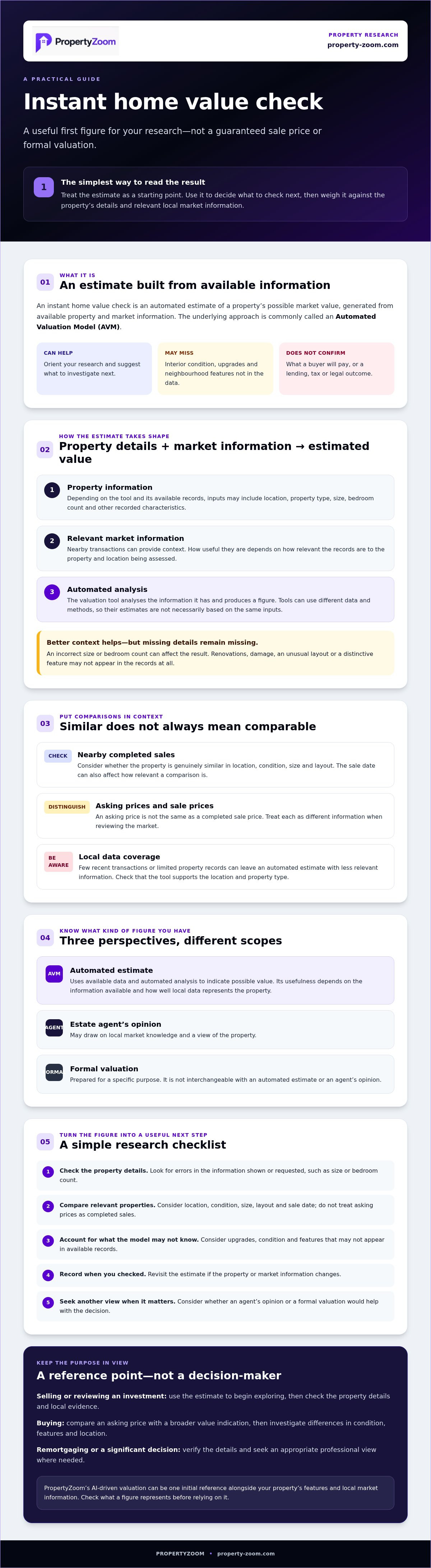
How to get a more useful result from an instant home value check
Use the estimate as the start of a short review, not the end of your research. This checklist can help you spot gaps, test whether the figure makes sense and decide whether you need more detailed guidance.
- Check the property details. Confirm the address, property type, size, bedrooms and any other information the tool displays or asks you to provide. Correct errors before assessing the result.
- Note the estimate date and scope. Record when the figure was generated. Check whether the tool explains its data coverage or shows a range. If it provides a range, treat it as context rather than a promise. If it gives one figure, don’t assume it represents a precise value.
- Review relevant local sales. Look for properties with similar locations, types, sizes and features. Consider meaningful differences in condition, layout or recent improvements. A nearby home isn’t automatically a like-for-like comparison.
- Account for details the data may miss. Consider whether renovations, defects or distinctive characteristics could affect the property’s appeal but aren’t represented in recorded information.
- Revisit the figure when things change. A new estimate may be useful if the property has changed or market information has moved. Keep the date with your notes so you can distinguish a current reference from an older one.
What to do when your estimate seems too high or low
Start with the inputs. Recheck the address and property details, then compare the home with a small set of genuinely similar local examples. Ask whether condition, improvements or unusual features could explain the difference. Also consider whether comparable sales are limited or don’t reflect the property well.
Don’t adjust the estimate by guesswork or treat it as a confirmed asking price. If a major financial decision depends on the figure, seek qualified, property-specific guidance before acting. For a deeper explanation of the technology and its limitations, read our instant property valuation guide.
Once you’ve checked the details and comparisons, the result can help shape your next research step. Explore PropertyZoom’s AI valuations for an initial indication, then review the estimate alongside property-specific information before making a decision.
Use PropertyZoom’s instant home value check as your next research step
Once you’ve reviewed an estimate and checked it against the property and its market, use it to guide what you investigate next. PropertyZoom offers instant AI-driven valuations as an initial way to explore a property’s value. The estimate can help frame questions, but it shouldn’t make a buying, selling or investment decision on its own.
Value is only one part of the picture. If you’re assessing an investment, consider an estimate alongside PropertyZoom’s investment scores and property search. This broader view can help you identify what to research further, without treating an automated figure or score as a guarantee of an outcome.
From a quick estimate to a better-informed property decision
Use the result to focus your next checks. Is the property’s asking price supported by similar homes? Could its condition or features explain a difference? What else do you need to know before deciding? For further context on AI valuation, read the AI-driven property valuation data guide. If you’re preparing to buy, the digital property buying guide offers a related next step.
When to take the next step beyond an instant check
If a significant decision depends on a detailed, property-specific assessment, seek appropriate professional advice. An instant estimate can’t replace that input. PropertyZoom also offers services for different stages of a transaction: surveying, mortgages and legal conveyancing. Each addresses a separate need, so consider which applies to your circumstances rather than assuming the estimate covers them.
For your next step, explore PropertyZoom’s property tools. Use an AI-driven valuation as an initial reference, then bring together the property details, market evidence and professional guidance relevant to your decision.
Turn your estimate into a confident next step
An instant home value check is most useful as a starting point, not a final answer. Check the property details, compare the estimate with relevant local sales and remember that condition, recent work and buyer demand can all shape the eventual price. If the decision carries significant consequences, seek property-specific professional guidance.
PropertyZoom offers instant AI-driven property valuations alongside AI property search and investment scores, helping you explore value as part of wider property research. Use those insights to guide your next questions, not to replace your own checks or professional advice.
Explore PropertyZoom’s property tools to take a practical next step with your property research. Use the estimate as a reference, then check it against the evidence and guidance relevant to your decision.
Frequently Asked Questions
What is an instant home value check?
An instant home value check is an automated estimate of a property’s possible market value, based on available property and market information. It gives you a quick reference for further research, rather than a guaranteed sale price or formal valuation. PropertyZoom offers instant AI-driven property valuations. Check what a specific tool’s result represents and how it expects you to use it before relying on the figure.
How accurate is an instant home value check?
Its accuracy depends on the quality and coverage of the information available, as well as how closely the property matches local market examples. An estimate may not reflect unrecorded alterations, current condition or distinctive features. Check the property details and compare the figure with relevant local evidence. No single accuracy level applies to every tool or home, so treat the result as an indication, not a promise.
Can I check my home’s value online for free?
Some online valuation tools may provide an estimate without charge, while others may have different access conditions. Check the specific platform’s terms before entering your details, including whether registration is required and what information you’ll receive. PropertyZoom offers instant AI-driven valuations, but confirm access requirements and any charges directly on the platform. Don’t assume every online estimate is free or includes the same level of detail.
What information do I need for an instant home value check?
The details required vary by valuation tool. A service may ask for an address or property characteristics, such as type, size or bedroom count, but don’t assume every platform uses the same inputs. Follow the tool’s prompts and check the information for errors before reviewing the result. Confirm PropertyZoom’s input requirements on its platform rather than inferring them from other valuation services.
Why is my online home estimate different from an agent’s valuation?
An online estimate is generated from available data, while an estate agent may draw on local knowledge and details gathered from viewing or discussing the property. The two may therefore use different evidence or reflect different dates and assumptions. Ask the agent what their opinion is based on, and check that your online estimate has accurate property details. Neither figure confirms the eventual price a buyer will agree.
Does an instant property estimate show what my home will sell for?
No. An instant estimate indicates possible value; it can’t predict the price a buyer will agree to pay. The asking price is set as part of a sale strategy, while the final transaction price depends on the agreement between buyer and seller. Demand, timing, negotiation and presentation can all affect the outcome. Use the estimate to guide research, not as a guaranteed sale figure.
When should I get a professional property valuation?
Seek a more detailed, property-specific assessment when a significant decision depends on evidence beyond an online estimate. This may be sensible for an unusual home, a property with substantial alterations or one with condition issues that available records may not show. If a lender, legal matter or tax situation requires particular valuation evidence, check its requirements and choose an appropriate professional assessment. An online estimate alone may not meet that need.


