

What if you could assess your next student accommodation opportunity without spending hours building spreadsheets? The right student housing investment tools can bring property search, valuation and yield analysis into a clearer workflow, helping you compare potential investments more consistently.
Manual data entry, outdated figures and disconnected services make niche markets harder to assess. A promising yield on paper is only part of the picture: location, university demand and the property itself also matter. AI can speed up analysis, but you still need to understand what sits behind each score and check whether an opportunity fits your goals.
This guide explores how AI-powered search, valuations and investment scores can help you identify and assess student accommodation opportunities. It covers what to consider when analysing potential yields, how conversational search can simplify property discovery, and how PropertyZoom brings student accommodation listings together with legal conveyancing, surveying and mortgage services. The aim is to make the route from finding a property to evaluating its investment potential more joined up.
Key Takeaways
- Use student housing investment tools to bring property search, valuation and investment analysis into a more joined-up process.
- Describe your requirements in a conversational search, then compare suitable student accommodation listings against your investment criteria.
- Use AI valuations and investment scores to assess opportunities, and check the data behind each result before making a decision.
- Look beyond headline yield by considering local demand, university strength, property quality and proximity to campus.
- PropertyZoom brings student accommodation listings together with search, valuations, investment scores, legal conveyancing, surveying and mortgages.
The Evolution of Student Housing Investment Tools in 2026
Student property research is moving beyond static databases and manually updated spreadsheets. Modern student housing investment tools can bring property information, valuation and investment analysis into one workflow. That matters in a niche where a building’s overall performance can hide differences between individual beds, room types and locations.
Spreadsheets still have a place, but their usefulness depends on accurate inputs and regular updates. A missed cost, stale rent assumption or inconsistent record can distort a yield estimate and make property comparisons unreliable. Treat a spreadsheet as a working model, not a live source of truth. Check its assumptions against current evidence before making an investment decision.
A connected PropTech platform can link discovery and analysis, reducing the need to move information manually between separate systems. Conversational AI can make search more intuitive: instead of trying filters one by one, you might describe your preferred student property, location and investment criteria in plain language. The system can then help narrow the search. Use the results to identify areas to investigate, not as a substitute for checking university demand, local supply and transport access.
What Defines a Modern Investment Tool?
Look for clear data dates and sources, not just a dashboard that appears current. The useful update cycle depends on the data: listing availability and valuation inputs may not change at the same pace. Conversational search should interpret your requirements, while valuation and risk features should explain the assumptions behind their outputs. For context on the calculations involved, Wikipedia’s overview of investment analysis tools outlines concepts such as cash flow and capitalisation rate. These calculations help with comparison; they don’t guarantee future returns.
Why Student Housing Requires Niche Software
General property research often centres on whole units. Student accommodation may require a closer look at income and occupancy by bed, as well as room mix. Compare campus distance and transport links, then consider how seasonal turnover could affect income and operating plans. Don’t assume a general-purpose tool captures these details automatically. Check which student-specific data it provides and what you’ll need to verify separately.
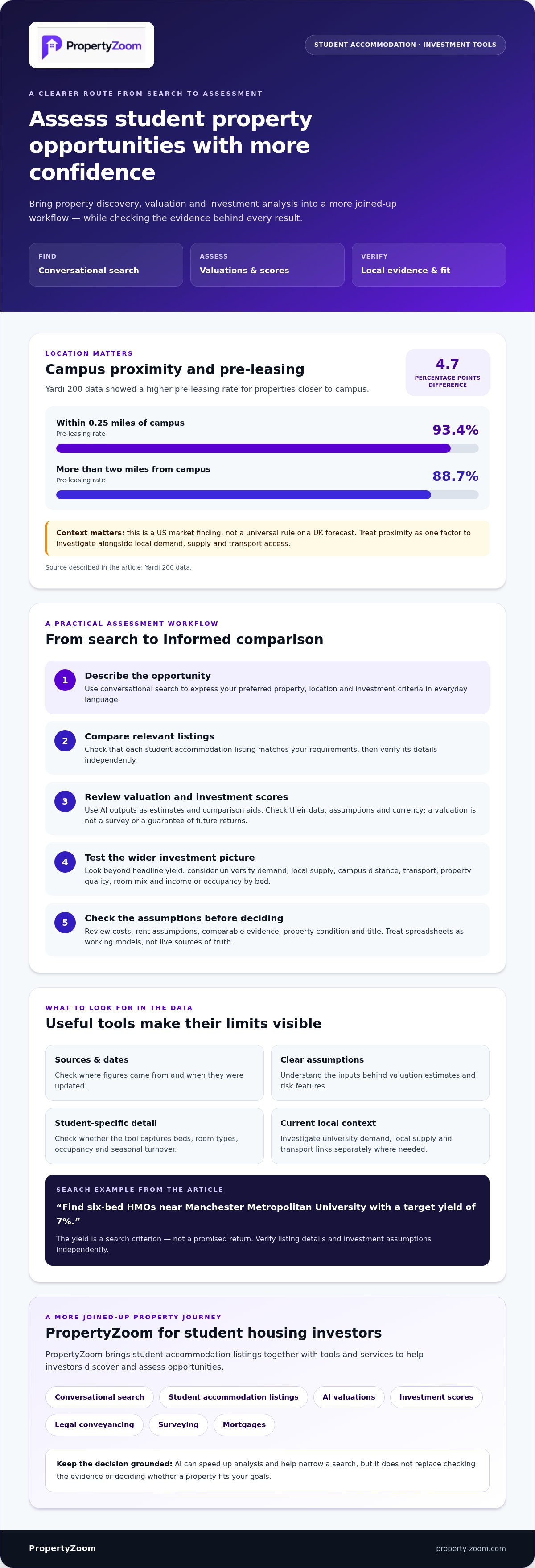
Location can change the picture. In Yardi’s August 2026 data for the Yardi 200, properties within 0.25 miles of campus had a 93.4% pre-leasing rate, compared with 88.7% for properties more than two miles away. This is a US market finding, not a universal rule or a UK forecast. It does show why proximity deserves careful analysis. PropertyZoom brings conversational AI search together with student accommodation listings, AI valuations and investment scores, giving investors a focused way to discover and assess opportunities.
Essential Features of Student Property Investment Research Software
Strong student housing investment tools should do more than collect listings. They should help you move from a specific search to a reasoned assessment, while making clear what the data can and can’t tell you. Prioritise conversational search, transparent valuation methods, useful investment scores and a practical way to handle enquiries.
AI Property Search vs. Traditional Filters
Traditional filters work well when you know exactly which boxes to tick. Conversational search lets you describe the opportunity you want in everyday language, then refine the results. For example: “Find six-bed HMOs near Manchester Metropolitan University with a target yield of 7%.” Treat the yield as a search criterion, not a promised return. Check whether listings match your requirements and verify their details independently. Learn more about using an AI property search platform to shape a focused property search.
This approach can reduce the need to test filter combinations manually. It may also help you explore criteria you hadn’t thought to combine. PropertyZoom offers conversational search and student accommodation listings, so you can express your requirements directly and assess relevant opportunities.
Automated Valuations and Investment Scoring
An AI valuation gives you an estimate to compare with an asking price. It isn’t a survey or a substitute for checking a property’s condition, title, comparable evidence and local market context. Ask what information supports the estimate, how current it is and whether student-specific factors are represented. An instant property valuation online can help you screen an opportunity, but use professional surveying where appropriate before proceeding.
Investment Scores can help you prioritise properties, but a single number needs context. Check which inputs inform it, whether assumptions are visible and how it treats occupancy, local student demand and relevant HMO licensing considerations. Don’t assume every platform includes these factors. Compare the score with your own cash-flow assumptions and evidence, and investigate any gap between the model and the asking price.
Lead handling matters once interest turns into enquiries. Look for a clear way to capture and organise leads, and check what the platform supports before relying on it for time-sensitive responses. PropertyZoom offers Zeba Calls AI for lead handling, alongside search, valuations and investment scores. You can review PropertyZoom’s student accommodation listings as part of your research.
Analysing ROI: Using Investment Scores for Student Accommodation
An Investment Score can help you prioritise student property opportunities, but it isn’t a return forecast. If a tool displays a score from 1 to 100, first check what the scale means, which inputs it uses and whether a higher result reflects income potential, risk, growth prospects or a blend. PropertyZoom offers AI-driven Investment Scores, but you should still review the supporting evidence and test each property against your own assumptions.
Don’t treat a high score as proof of future capital growth. Growth depends on factors such as local demand, supply, property condition and wider market movements. Use the score to decide what deserves closer investigation, not to replace due diligence.
Yield vs. Growth: Balancing Your Portfolio
Compare student lets with traditional residential properties using consistent assumptions: purchase costs, achievable rent, void periods, maintenance and management costs. A stronger gross yield may not translate into stronger net income. To assess a potential growth case, look for verifiable evidence, such as published university expansion plans, then consider whether the proposed change could affect local housing demand. Treat plans as context, not a guarantee. The right balance depends on your investment aims and tolerance for risk.
For larger halls, AI for commercial real estate valuation can help frame the valuation questions to investigate. Check the model’s assumptions and compare its estimate with relevant market evidence and professional advice.
Risk Mitigation Tools
Use digital analysis to flag questions early, then verify them with reliable local sources. For each potential property, check:
- Planning context: Confirm with the relevant local authority whether an Article 4 direction applies and what it means for the property.
- Local competition: Review nearby student accommodation and university demand. A postcode with plentiful listings may need closer scrutiny than a simple yield figure suggests.
- Net income assumptions: Include realistic maintenance, management and vacancy allowances. Change the assumptions to see how sensitive the projected return is.
These checks make an AI score more useful by showing where uncertainty sits. Student housing investment tools can organise the analysis, but they can’t confirm a property’s planning position or guarantee future occupancy. Keep a record of your sources and assumptions so you can compare opportunities consistently.
PropertyZoom combines Investment Scores with property search and AI valuations. You can review PropertyZoom’s investment tools as one part of your research, then validate the details before committing.
How to Organise Your Student Portfolio with Integrated Ecosystems
A student property purchase can involve several moving parts: finding a suitable listing, assessing its condition, arranging legal conveyancing and exploring mortgage options. Using separate providers and records can make it harder to keep track of the next step. An integrated platform brings these services into one broader workflow, helping you organise the process without implying that every step happens automatically.
For a practical overview of where digital tools can support a purchase, read this guide to the property buying process. Keep your own checklist alongside any platform. Record key documents, questions and decisions, and confirm responsibilities and timescales directly with the relevant professionals.
Digital Conveyancing and Surveying
Legal conveyancing and surveying address different parts of a purchase. Conveyancing supports the legal transaction; a survey helps you assess the property’s condition. Having both available within a wider property ecosystem can make it easier to consider these needs while reviewing a listing. It doesn’t remove the need to check what each service includes, request relevant details and decide which survey is appropriate. Don’t assume instant quotes, reduced fall-through rates or digital property models are included unless confirmed.
Mortgage Integration for Faster Completion
Mortgage options should fit the property and your circumstances. Student accommodation may involve different considerations from a standard residential let, so check whether a lender will assess the specific property type and intended use. A platform that also offers mortgages can bring that part of your research closer to property search, but it doesn’t guarantee faster approval or completion. Ask about eligibility, rates, application requirements and document handling directly.
Student housing investment tools can also help you think beyond the academic year. Some investors may explore contractor stays as a potential use for suitable accommodation during quieter periods. Treat this as an option to assess, not assured summer occupancy. Compare likely demand, property suitability and practical requirements before including it in your figures. PropertyZoom offers student accommodation and contractor stay listings, alongside legal conveyancing, surveying and mortgages.
Enquiries need organisation too. Zeba Calls AI is offered for lead handling and may help investors manage incoming interest. Check how it fits your enquiry process before relying on it. To review these property-related services together, visit PropertyZoom’s property platform.
PropertyZoom for Student Housing Investors
PropertyZoom brings conversational AI search, student accommodation listings, AI valuations and Investment Scores into one platform. This gives investors a joined-up way to discover and assess opportunities, rather than starting with a broad property search and piecing together separate research tools.
Use the search to describe the property type and location you’re looking for. Then review relevant listings and use valuations and Investment Scores to help decide which opportunities merit further checks. Scores can support comparisons, but they don’t promise returns or replace your own assessment of demand, costs, condition and risk.
Getting Started with Conversational Search
Begin with clear criteria: location, accommodation type and the features that matter to your investment plan. Refine your search as you learn more about available listings. Before relying on alerts or automated monitoring, check whether those functions are available and how they work. An AI valuation can offer a reference point when reviewing an asking price, but it isn’t a guarantee of market value. Use it alongside comparable evidence and professional advice.
For investors, a practical advantage is having niche student accommodation listings alongside search and analysis features. PropertyZoom also offers Contractor Stays, which may be relevant when assessing other potential uses for suitable accommodation. Don’t assume a different tenant market will provide occupancy or income; assess local demand and property suitability separately.
The Power of the PropertyZoom Ecosystem
Property research is only one part of a purchase. PropertyZoom also offers legal conveyancing, surveying and mortgages, helping investors access related services within the same platform. Each has a distinct role, so confirm the scope, requirements and next steps with the relevant service before proceeding. An integrated route can make the process easier to organise, but it can’t guarantee faster completion or prevent a transaction from falling through.
Zeba Calls AI is available for lead handling. Investors and agents can consider how it fits their enquiry process and confirm its specific capabilities before relying on it for particular tasks. It may support enquiry management, but don’t assume round-the-clock coverage or a particular response time.
PropertyZoom’s offering includes student accommodation listings, AI valuations and Investment Scores. Don’t assume it covers every global market, provides custom deal alerts or includes specific design features unless those capabilities are confirmed. When comparing student housing investment tools, focus on functions you can verify and the evidence behind their outputs. A clear workflow starts with discovery, continues with careful checks and ends with an informed decision.
Make Your Next Student Property Search More Focused
In 2026, effective student housing investment tools can help you move from broad searching to a more organised assessment. Conversational search can clarify what you’re looking for, while AI valuations and Investment Scores help you compare opportunities. Treat their outputs as decision support, then verify property details and assumptions before proceeding.
PropertyZoom brings student accommodation listings and AI-driven Investment Scores together, with technology powered by ZEBA AI. Its wider offering includes legal conveyancing, surveying and mortgages, so you can explore related services within one platform rather than treating discovery as a standalone task.
Ready to put a more focused search into practice? Start your AI-powered student property search on PropertyZoom and explore listings that match your investment criteria. Use the tools to clarify your requirements, ask better questions and decide what to investigate next.
Frequently Asked Questions
What are the best student housing investment tools for beginners in 2026?
For beginners, useful tools make property search, valuation and investment analysis easy to understand. Look for student accommodation listings, conversational search, transparent Investment Scores and a clear explanation of the data behind each result. PropertyZoom combines these features with access to legal conveyancing, surveying and mortgages. Start with a specific investment brief, compare listings and independently check the assumptions before making a decision.
How accurate are AI property investment scores for student lets?
AI investment scores can help you compare opportunities, but they can’t guarantee a property’s future performance. Their usefulness depends on the information and assumptions used, including whether the data is current and relevant to student accommodation. Check what the score measures and whether factors such as demand, occupancy and costs are included. Treat the result as a screening aid, then verify important details and calculate your own expected returns.
Can conversational AI search really find better deals than manual filters?
Conversational AI can make it easier to express detailed requirements in plain language, such as a preferred university area, property type and target yield. It may surface relevant listings without repeatedly adjusting separate filters. That doesn’t mean it will always find a better deal: results depend on the listings and search data available. Use conversational search to refine discovery, then compare properties and verify each opportunity yourself.
Do I need separate software for student housing valuations and mortgages?
Not necessarily. Some property platforms combine search, valuations and mortgage services, so you may be able to organise several parts of your research in one place. PropertyZoom offers AI valuations and mortgages alongside student accommodation listings. These services have different purposes: a valuation is an estimate, while mortgage suitability depends on the lender and your circumstances. Confirm each service’s scope and requirements before relying on it.
How does PropertyZoom help manage student housing enquiries?
PropertyZoom offers Zeba Calls AI for lead handling. Estate agents can use the platform’s lead capture and appointment-booking capabilities to help organise incoming enquiries. Check which features suit your workflow and how they handle enquiries before relying on them for a particular task. The platform’s student accommodation listings provide a niche property-search option, while AI Property Search helps users discover listings using conversational queries.
What is the difference between a student housing search engine and a general property site?
A student housing search tool focuses discovery on accommodation relevant to students, rather than relying only on broad residential categories. Depending on the platform, investors may be able to search listings alongside features such as AI valuations or Investment Scores. Check whether it provides useful details about location, property type and room configuration. A general property site may still help with comparisons, but assess whether its listings suit student investment research.
How much do student housing investment tools typically cost?
There isn’t a single verified typical cost for student housing investment tools. Charges depend on the provider and what its platform includes, so compare the current terms directly rather than relying on an assumed market average. Check whether access fees apply, which features are included and whether separate service charges or referral arrangements are relevant. Don’t assume a particular price or free access unless the provider confirms it.
Is it possible to automate the legal process of buying student property?
Digital tools can help organise information and connect property research with legal conveyancing, but they don’t remove the need for legal work or professional oversight. PropertyZoom offers legal conveyancing as part of its property ecosystem. Ask the conveyancing provider what steps can be handled digitally, what documents you’ll need and who will manage the legal aspects. Review the transaction carefully, and don’t treat automation as a substitute for legal advice.


