

If you need to know how to challenge a property valuation UK-wide, first identify who produced it and what it’s for. An estate agent’s marketing appraisal, a lender’s mortgage valuation and a council tax band decision follow different routes. The right evidence and next step depend on the type of valuation.
It’s frustrating when a figure seems out of step with similar local properties, especially when a sale, purchase or financial decision is waiting. But disagreeing with the number may not be enough, and contacting the wrong organisation can waste time. Start by checking the report for factual errors, then gather relevant, verifiable evidence, such as comparable sales or details of improvements that may have been missed.
This guide explains how to identify the responsible organisation, choose the right review or appeal route, and prepare a clear evidence pack. It also covers what to expect if the valuation is upheld and how to consider practical next steps without assuming every challenge follows the same timetable. The aim is to challenge the evidence and the route, not just the headline figure.
Key Takeaways
- To understand how to challenge a property valuation UK-wide, match your evidence to the valuation’s purpose, date and property type.
- Compare like with like, and explain how nearby sale properties differ in size, condition, location or timing.
- For a mortgage valuation, follow the lender’s stated review process and check who it has nominated to assess the figure.
- Keep the valuation, supporting evidence, correspondence and key dates together so you can track your case clearly.
- An online estimate can provide another point of comparison, but it won’t replace a formal review or determine its outcome.
How to challenge a property valuation UK: identify what the figure means
The right challenge route depends on who produced the valuation and why. A mortgage lender, estate agent, online tool and public authority may assess the same property for different purposes, using different evidence and processes. Before deciding how to challenge a property valuation UK-wide, identify the source and the decision the figure supports.
A property valuation challenge is a request for the responsible organisation to review the evidence or assumptions behind a figure. A higher offer, asking price or sale price may be relevant context, but disagreement alone doesn’t show that a valuation is inaccurate. Any comparison needs to fit the valuation’s purpose, date and basis. For background on what is a property valuation, see this overview of appraisal and its different uses.
Which type of UK property valuation do you want to challenge?
A mortgage valuation helps a lender assess a property in relation to its lending decision. It isn’t necessarily a full inspection of the home’s condition. An estate agent appraisal is usually prepared to inform a marketing price, whilst an online estimate is generated from available property data and may not account for every feature or change inside the home. These are not interchangeable with a formal assessment by a lender or public authority.
Check the report, covering letter, email or online tool terms. Look for the organisation that issued the figure, its stated purpose, the valuation date and any explanation of the method used. If the document is unclear, ask the sender to confirm who is responsible for a review and how to request one.
Who handles a council tax band challenge across the UK?
For relevant council tax band matters in England and Wales, the Valuation Office Agency (VOA) is the assessment body. Its role and the route available can depend on the circumstances, so check the current guidance before submitting a challenge. In Scotland, council tax assessments are handled through local assessors. Northern Ireland has a separate system administered by Land & Property Services.
Don’t assume a process or deadline applies across all four nations. Confirm your eligibility, time limits, evidence requirements and submission route with the relevant authority. If your valuation came from a lender, agent or online tool, a council tax banding route won’t resolve that separate issue.
What evidence can help you challenge a property valuation?
Strong evidence connects directly to the valuation date, the property and the assessment’s purpose. Start with the report’s assumptions, then show precisely what is wrong or incomplete. A general claim that the figure feels too low or high is less persuasive than a factual correction supported by documents.
Useful evidence can include comparable completed sales, verified property details, dated photographs, floor plans and records of relevant repairs or improvements. Choose material that supports a specific point, and separate confirmed facts from estimates or personal opinion. For council tax band matters in England and Wales, check the official government guidance for the applicable process and evidence requirements.
How to choose comparable property sales
Look for nearby homes with a similar property type, size and condition that sold close to the valuation date. Explain why each sale is a useful comparison, then note differences that could affect value, such as an extra bedroom, a larger plot, a different location or a more recent renovation. Check completed sale details through credible sources, including HM Land Registry data where applicable. Don’t present an asking price as a completed sale price.
Timing matters. A sale well before or after the valuation date may reflect different market conditions, so state the transaction date and why you believe it remains relevant. If you’re learning how to challenge a property valuation UK-wide, a short comparison table can help. List each address or reference, sale date, confirmed price, key similarities and material differences.
How to document errors and property-specific factors
Make factual corrections easy to verify. If the report records the wrong floor area, property type or features, identify the exact entry and attach supporting documents, such as a floor plan or property record. Dated photographs can show condition at the relevant time. Repair records or invoices may support claims about completed work or unresolved defects.
Include location, access or restrictions only if they affect the valuation basis. For example, explain a documented access issue rather than simply calling the location undesirable. Avoid unsupported claims about defects, market movement or the price you think the home should achieve.
- Fact: The report states a different floor area from the attached plan.
- Evidence: The plan identifies the measured area and property address.
- Relevance: Explain why correcting that detail could affect the assessment.
For another point of comparison during your research, you can review AI-driven property valuation estimates. Treat an online estimate as additional context, not as proof or a replacement for the valuation’s formal review process.
Compare the UK challenge routes before you submit a review
The first step in learning how to challenge a property valuation UK-wide is matching your request to the organisation that issued the figure. A lender review, a council tax band challenge and a request to revisit an agent’s appraisal are different processes. Check the organisation’s current instructions before sending evidence. Eligibility, deadlines and next steps can depend on the valuation type and where the property is.
Use this overview to identify your starting point. It isn’t a substitute for checking the relevant organisation’s latest procedure.
| Valuation source | First contact | Useful evidence | Likely next step |
|---|---|---|---|
| Mortgage lender or nominated valuer | The lender, using its stated review route | Specific factual corrections, relevant comparable sales and documents supporting overlooked features or improvements | The lender considers the request under its process and decides how to respond |
| Council tax band in England or Wales | Valuation Office Agency (VOA), where its process applies | Evidence that addresses the band assessment and meets the current criteria | Follow the VOA’s current review route and any further appeal instructions |
| Council tax band in Scotland | The local assessor | Evidence relevant to the assessment and grounds for review | Check the assessor’s process for review or appeal |
| Domestic rates assessment in Northern Ireland | Land & Property Services (LPS) | Evidence relevant to the rating assessment | Check LPS guidance for the available review or appeal route |
| Estate agent appraisal or online estimate | The agent or estimate provider | Corrected property details and relevant sales evidence | Ask for an explanation, correction or reassessment. This is usually not a formal appeal |
Challenging a mortgage valuation or lender decision
Ask the lender how it accepts factual corrections or comparable evidence, and whether it wants the information sent to its nominated valuer. Keep the request focused: identify the report detail you dispute and attach evidence that supports the correction. The lender may control the valuation process and its lending decision. A review doesn’t guarantee a second valuation, a revised offer or a changed figure. For context on how professional residential valuations are approached, see the RICS valuation standards.
Challenging an official council tax band
Keep this route separate from a mortgage valuation or a disagreement about an asking price. The responsible body and process differ across England, Wales, Scotland and Northern Ireland. Confirm the current criteria, eligibility, terminology, deadlines and submission method with the relevant authority before acting. Don’t assume that a process available in one nation applies elsewhere, or that a general complaint is the correct formal challenge.
For agent appraisals and online estimates, start by asking the provider to explain or check its assumptions. These discussions can help clarify the figure, but they don’t replace a formal lender or public authority review. Verify procedural details against current official guidance before submitting.
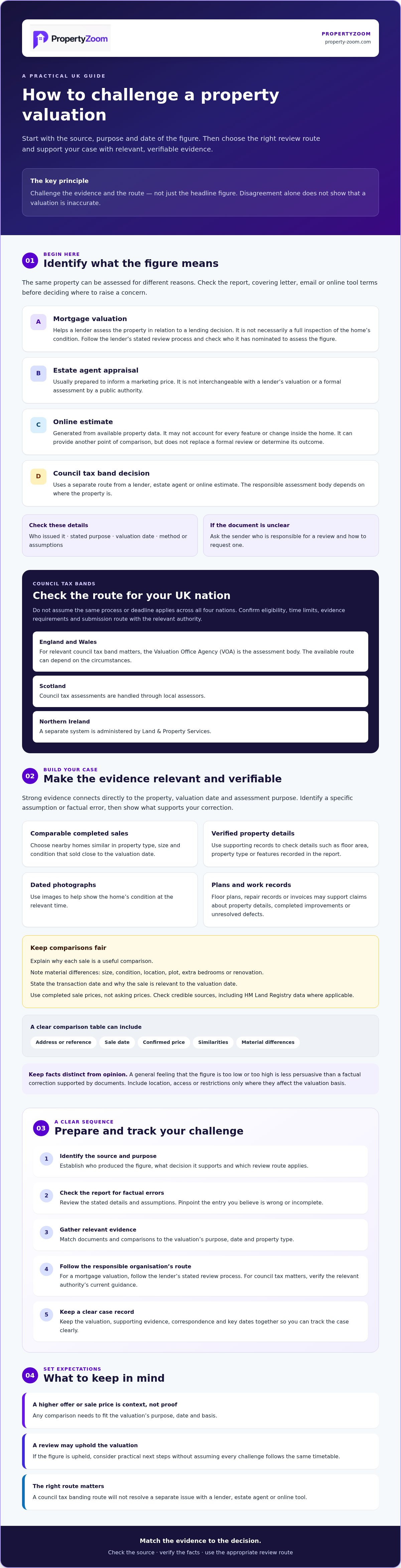
How to challenge a property valuation: a clear step-by-step process
A clear, well-organised request makes it easier for the responsible organisation to understand what you dispute and why. The process for how to challenge a property valuation UK-wide varies by valuation type, so follow the recipient’s current instructions and check any deadlines before submitting.
- Identify the source. Confirm who issued the figure, its purpose and the correct organisation to contact.
- Check the basis. Review the valuation date, recorded property details and assumptions. Pinpoint any factual error or relevant evidence that may have been missed.
- Gather evidence. Select documents that support each point, such as comparable completed sales, a floor plan or dated photographs.
- Submit clearly. Use the organisation’s official channel. State what you want reviewed and connect each piece of evidence to the issue.
- Track the response. Record when you submitted the request, save correspondence and note any reply dates or next steps.
Prepare and submit a focused challenge
Open with the valuation’s date and reference, the figure you’re challenging and the precise point you want reviewed. For example: “The report dated [date] records the property’s floor area as [figure]. The attached plan shows [correct detail].” Keep the wording factual and concise.
Label each attachment and refer to it in your explanation. A short evidence list helps the reviewer see what each document supports. Send the request through the stated official route, retain a copy of everything and follow any instructions about format, eligibility or deadlines.
Keep one organised record, whether digital or paper. Include the original valuation, your evidence, the submitted request, messages and a timeline of dates. If the organisation asks for clarification, respond to the specific question and keep a copy of your reply.
For an additional point of comparison during your research, read about instant property valuation online. An online estimate can support your broader property research, but it isn’t a formal valuation or a substitute for the organisation’s review.
What to do if the valuation is not changed
If the original figure stands, ask for the reasons and whether another review, complaint or appeal route is available. Check the instructions carefully. Routes, deadlines and any costs can vary, so verify them with the responsible organisation before deciding what to do next.
Consider whether independent professional advice is appropriate for the decision at stake. A complex dispute or significant factual issue may call for a qualified professional’s input, but not every disagreement requires a separate survey. Weigh the potential value of further advice against your circumstances, and confirm the scope and terms before proceeding.
What happens next and when an online valuation can help
A review may change the figure, clarify how it was reached or uphold the original assessment. The outcome depends on the evidence and the organisation’s process. If the figure stands, ask for the reasoning and check whether a further review, complaint or appeal route is available. Confirm any applicable deadline and requirements directly with the responsible organisation.
Further professional advice may help if the dispute involves complex property details or a decision with substantial consequences. But a difference of opinion alone doesn’t mean you need to commission another survey. First consider what remains unclear, what evidence you already have and whether professional input could address a specific gap.
Use online estimates as context, not a verdict
An online estimate can provide another data point for property research, but it isn’t proof that a formal valuation is wrong. Automated tools may not reflect a home’s condition, renovations or other property-specific details. Compare estimates cautiously. Check the date, assumptions and property information behind each figure, and treat differences as prompts to investigate rather than conclusions.
PropertyZoom offers AI-driven valuations and investment scores as research tools. They can help you compare a figure with other property data, but they aren’t a formal survey, a lender’s decision or a guarantee of an appeal outcome. For more context, consult the guide to AI-driven property valuation accuracy.
Choose a practical next step for your situation
If the disputed figure came from a lender, contact the lender first and ask how it handles review requests. An online estimate won’t replace the lender’s process. If the issue is a council tax band, confirm the responsible assessment body and current route for your nation. Don’t assume the same criteria or escalation process applies across the UK.
To keep your decision focused, ask yourself: what organisation issued the figure, what specific point remains disputed, and what evidence could address it? If you have a new document or a clear factual correction, submit it through the organisation’s stated process. If you don’t, seek clarification before deciding whether to escalate.
For a further comparison point in your property research, explore PropertyZoom’s property valuation tools. Use estimates as context, then direct any formal challenge to the organisation responsible for the valuation.
Take your next step with a clear plan
The most effective way to challenge a property valuation UK-wide is to start with the source: identify who issued the figure, check its purpose and follow that organisation’s current review process. Build your request around relevant, verifiable evidence, such as comparable sales or documents that correct a factual error. Keep a clear record of what you submit and be prepared for the figure to be changed, clarified or upheld.
Online estimates can add context to your property research, but they don’t prove a formal valuation is wrong or replace a lender’s or authority’s decision. PropertyZoom provides AI-driven property valuations alongside property search and investment scores, giving you additional information to consider as you research.
Explore PropertyZoom’s property valuation tools to add another point of comparison to your property research. Use estimates as context, then direct any formal challenge to the organisation responsible for the valuation.
Frequently Asked Questions
Can I challenge a property valuation in the UK?
Yes, you can ask the organisation responsible to review a valuation, but the route depends on its purpose. A lender’s valuation, an estate agent’s appraisal, an online estimate and a council tax band assessment follow different processes. Start by checking who issued the figure and what it was used for. Then confirm the organisation’s current review procedure, evidence requirements and any relevant deadline before submitting your request.
How do I challenge a mortgage valuation in the UK?
Contact the lender or the organisation that arranged the valuation and ask how it accepts review requests. Point to a specific issue, such as an incorrect property detail, and support it with evidence like relevant completed sales or an accurate floor plan. The lender controls its process and may uphold the original figure. A challenge doesn’t guarantee a new valuation or revised mortgage offer, so ask how the review could affect your application.
What evidence do I need to challenge a property valuation?
Use evidence that relates directly to the property, valuation date and assessment basis. This may include comparable completed sales, accurate floor plans, dated photographs or documents confirming features, improvements or condition. Explain what each item demonstrates and why it matters to the valuation. Verify details where possible, and distinguish documented facts from assumptions. Asking prices and personal opinions alone may not establish that the valuation is inaccurate.
Can I challenge my council tax band in the UK?
There may be a route to question your council tax band, but the responsible body and rules depend on where the property is. The Valuation Office Agency handles relevant band matters in England and Wales. Scotland and Northern Ireland have separate assessment arrangements. Check the appropriate authority’s current eligibility criteria, evidence requirements, submission method and deadlines before acting. Don’t assume that a process available in one nation applies across the UK.
How long does it take to challenge a property valuation?
There’s no single UK-wide timescale. The response period depends on the type of valuation, the organisation handling the request, the evidence provided and whether it needs more information. Check the relevant process guidance for any estimated timeframe. Keep a record of your submission date and follow up through the stated channel if needed. If a sale, purchase or financial decision is time-sensitive, don’t rely on an assumed response deadline.
Will challenging a property valuation change my mortgage offer?
Not necessarily. A lender may review your evidence and still keep its original valuation, and a challenge doesn’t guarantee a different lending decision. Ask the lender what review process is available and whether it could affect your application timeline. If the valuation remains unchanged, discuss your options directly with the lender before making financial or contractual decisions. Don’t assume that an online estimate or an agent’s appraisal will alter the lender’s assessment.
Can an online property valuation help me challenge a valuation?
An online estimate can provide another point of comparison, but it doesn’t prove that a formal valuation is wrong. Automated estimates may not reflect a property’s condition, improvements or specific features. Check the estimate’s date, property details and assumptions, then compare it cautiously with relevant completed sales. PropertyZoom’s AI-driven valuations can support property research, but they aren’t formal surveys or lender decisions. Direct a formal challenge to the organisation responsible for the disputed figure.


