

What if an AI-generated property insight gives you a starting point, not an answer? Property market insights AI can help organise scattered information and reveal patterns, but a confident-looking score doesn’t explain which evidence supports it or whether it fits your decision.
If you’re comparing areas, assessing a potential investment or trying to make sense of changing market signals, fragmented sources can make like-for-like comparisons difficult. Before relying on a signal, check what it measures, where it applies and whether it relates to the property type you’re considering.
This article explains how AI analyses property-market information, how to assess an insight’s reliability and relevance, and how to use it to decide what to investigate next. It also explains how to treat tools such as PropertyZoom’s AI valuations and investment scores as prompts for further research, not substitutes for independent checks or professional advice.
Key Takeaways
- Use property market insights AI to spot patterns and build market context, not as a substitute for an individual valuation or recommendation.
- Check how well the underlying data covers the relevant area, property type and time period before relying on a signal.
- Test each insight against its source, date, geography and stated uncertainty. A national trend may not reflect a specific street or property.
- Start with a clear decision question, then use the insight to identify what evidence to verify and what to investigate next.
- Consider how buyers, sellers, agents and investors might use the same market signal differently, depending on the decision they need to make.
What AI Property Market Insights Show About a Changing Market
Property market insights AI turns property-related data into interpretations of patterns, conditions and potential opportunities. It can help show how a market or location is changing, but it doesn’t make the decision for you.
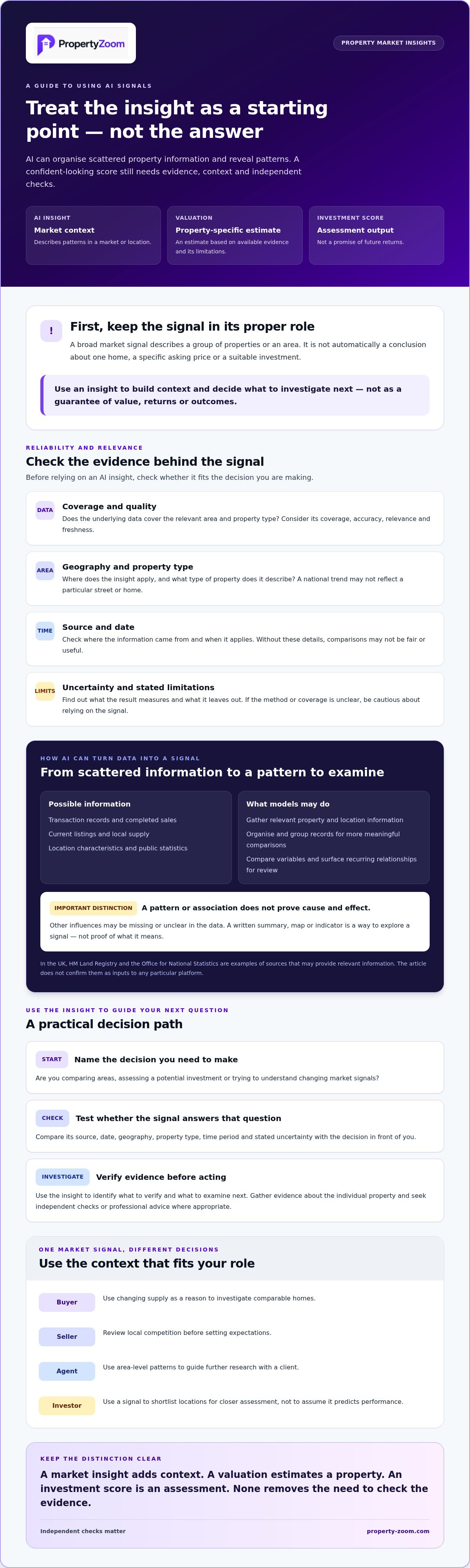
An AI property market insight is evidence-based context that can inform judgement, not a guarantee of value, returns or outcomes. A broad market signal describes a group of properties or an area. It isn’t automatically a conclusion about one home, a specific asking price or a suitable investment.
What counts as a property market insight?
Depending on the available data, an insight might bring together listing activity, sale trends and local supply. Each signal offers a different clue. For example, fewer available listings alongside a rise in completed sales could suggest tightening supply. It doesn’t prove that every property in the area is becoming more valuable. Property type, time period and local conditions still matter.
Available indicators vary by country, region, data source and property type. A useful insight should make clear what information it reflects and the area it covers. If those details are missing, you may not be able to compare it fairly with another location or use it to answer your specific question.
Market insight, valuation and investment score are not interchangeable
Market insight describes context about a market or location. Valuation estimates a particular property’s possible value, based on available evidence and subject to its limitations. An Automated Valuation Model (AVM) is one approach to estimating value using property data. Consider its output alongside relevant evidence about the individual property.
An investment score is an assessment output, not a promise of future returns. Its meaning depends on how it is calculated and what information it considers. Don’t treat it as interchangeable with a valuation or a wider market analysis.
The same market insight can support different next steps. A buyer might use changing supply as a reason to investigate comparable homes. A seller might review local competition before setting expectations. An agent could use area-level patterns to guide further research with a client. An investor might use a signal to shortlist locations for closer assessment, rather than assume it predicts performance.
Keep the insight in its proper role: a starting point for a better question. Check what it covers, then gather property-specific evidence before acting.
How AI Turns Property Data into Market Signals
AI can help turn fragmented property information into signals that are easier to compare and investigate. The process depends on what information is available, how consistently it’s recorded and whether it fits the question being asked. For property market insights AI, useful output starts with relevant inputs and a clear purpose.
Which property data can inform market analysis?
Depending on the market and the analysis, possible inputs include transaction records, current listings, location characteristics and public statistics. In the UK, HM Land Registry and the Office for National Statistics are examples of sources that may provide relevant information. Their data is not confirmed as an input to any particular platform. Availability and definitions vary between countries, regions and property types, so check what a tool actually uses.
Transaction records may show completed sales, whilst listing information can indicate what is currently being offered. Local statistics may add context about an area. Read together, these categories can help frame a question, but they don’t necessarily explain why a pattern exists. For example, a change in listing activity is a reason to examine the local market more closely, not proof of what caused that change.
How models identify patterns and present results
Machine-learning models can compare multiple variables and surface recurring relationships for further review. They might identify that certain property characteristics appear alongside different sale patterns in a given dataset. That is an association, not proof that one characteristic caused the other. Other influences may be missing or may not be represented clearly in the data.
Results may be presented as a written summary, map or indicator, depending on the tool. Treat these as ways to explore a signal, not proof of its meaning. An AI-generated pattern is only as dependable as the coverage, accuracy, relevance and freshness of the data behind it.
A four-step view makes the process easier to assess:
- Gather: Collect relevant property and location information from available sources.
- Organise: Standardise and group records so comparisons are more meaningful.
- Analyse: Compare variables to identify patterns that may merit attention.
- Present: Show the output in a format that helps people review and investigate it.
For commercial property research, wider economic context may also matter. Brookings’ Financing the AI buildout discusses the investment and infrastructure involved in expanding AI, including data centres. This can help frame questions about changing demand, but it shouldn’t be mistaken for a property-specific forecast.
Before relying on a result, ask what data it reflects and whether it matches the area, period and property type you care about. You can also explore PropertyZoom’s property platform to bring property discovery and AI-supported research together.
How to Judge AI Property Market Insights Before Acting
A clear chart or confident summary can make an AI insight feel definitive. It isn’t. The result may reflect incomplete records, a broad geographic area or a time period that no longer matches current conditions. Treat it as a prompt to check the evidence, not as proof of what a property is worth or what a market will do next.
Check the evidence, date and local fit
Before using property market insights AI to shape a decision, check what the output is based on. Look for an identifiable source, the date of the underlying information and a clear description of its coverage. Then ask whether the comparison matches your question. A trend across a whole country may conceal differences between regions, neighbourhoods and individual streets.
Use this checklist to assess whether an insight is relevant:
- Source: Can you identify where the information came from and what it measures?
- Date: When was the information collected? Could conditions have changed since then?
- Geography: Does the area covered match the location you’re considering?
- Property type: Are you comparing similar homes or buildings, rather than mixing unlike properties?
- Uncertainty: Does the output explain limitations, gaps or how much confidence to place in the result?
Comparisons also need to account for relevant differences such as condition and time period. An area-level trend can help you decide what to investigate, but it can’t tell you whether a particular building has defects, whether a specific home has features that affect its value, or whether local demand supports your plans. Check those details separately. When comparing two properties, confirm that the evidence relates to a similar property type and period before drawing conclusions from the difference.
Recognise uncertainty, bias and missing context
Some locations or property types may be represented unevenly in the available data. If records are sparse, outdated or inconsistent, an apparent pattern may be less dependable. Ask what is missing and whether the insight might overlook local factors. A polished presentation doesn’t remove these limitations.
Historic patterns describe what appeared in the information analysed. They don’t establish future prices, demand or investment returns. Even a strong-looking signal can change as market conditions shift, and an association in the data doesn’t guarantee the same outcome for another property.
For consequential decisions, verify AI insights against current, property-specific evidence and seek advice from a suitably qualified property professional. Use the insight to sharpen your questions, then confirm the details that matter before you act.
A Practical Workflow for Using AI Market Insights
Make an AI insight useful by connecting it to a decision, checking the evidence and choosing a clear next step. This keeps property market insights AI focused on your needs, rather than letting a dashboard dictate what to do.
Start with a decision, not a dashboard
Before searching, define what you’re deciding, where you’re looking, which property type matters and your time horizon. “Is this area worth investigating for a flat purchase over the next year?” gives you a clearer starting point than “Show me the best market”. Use AI to narrow the questions and locations to research, not to select a property automatically.
If discovery is your first step, see the existing AI Property Search Platform: The Smarter Way to Find and Invest in 2026 article for more on using AI in property search.
Compare signals and decide what to verify
Compare like with like. If you’re assessing two locations, note whether the insight covers the same period and similar property types. Record differences in the evidence, too. One area may have more listing activity, whilst another has a different pattern in completed sales. Neither signal alone settles the decision.
Turn each promising pattern into a follow-up question. If an area appears to have increased demand, what current evidence supports that? If a property seems to stand out, what documents or professional checks could confirm the details? For valuation-specific questions, consult the Instant Property Valuation Online guide, then assess any estimate in light of the property and its available evidence.
Keep a simple decision log as you go:
- Decision: What are you trying to decide?
- Insight: What pattern did the AI surface, and what information appears to support it?
- Assumptions: What are you taking as true but haven’t verified?
- Open questions: What evidence or professional input is still needed?
- Next action: What will you check or investigate now?
The same signal can lead to different actions. A buyer might use it to shortlist an area for further property checks. A seller could compare local competition before reviewing their plans. An agent may use it to prepare questions for a client discussion. An investor could use it to decide which locations warrant deeper research, without treating the signal as a return forecast.
AI can help organise your research, but keep the final step grounded in evidence relevant to your decision. Explore PropertyZoom’s AI property tools as part of your property research.
How PropertyZoom Brings AI Property Insights into One Platform
PropertyZoom brings property discovery and AI-supported research together for buyers, sellers, agents and investors. Its tools serve different purposes: conversational search helps users describe what they’re looking for, AI valuations provide estimates of possible property value, and investment scores offer a separate assessment output. Each can inform research, but none guarantees a particular result.
Explore property opportunities with AI-supported tools
Conversational search lets users express property needs in everyday language, which can help narrow a search and identify options to investigate. For example, a buyer can describe the type of home and location they have in mind, then review relevant listings rather than treating a search result as an automatic decision.
Valuations and investment scores should also be read as inputs, not conclusions. Consider the evidence and limitations relevant to your question, then verify important details independently. If you want to understand scores in more depth, the Real Estate Investment Scores pillar offers a focused next read.
PropertyZoom also includes specialised listings for student accommodation, land and commercial property. These categories can help readers focus their discovery on a particular property need, whilst leaving them to assess each opportunity on its own evidence.
Move from research towards a property decision
Property research is only one part of a property decision. PropertyZoom’s wider platform also includes legal conveyancing, surveying and mortgages. These are distinct services within the platform, not a guarantee that any transaction will proceed or that a particular outcome will be suitable. Check the details of each service and consider the professional advice your circumstances require.
Agents can also use the platform to create listings, enhance photos and generate video walkthroughs, with lead capture and appointment booking through Zeba Calls AI and integrated calendar management. These tools support the agent’s property workflow; they don’t replace checks on the accuracy of listing details or the suitability of an appointment.
Use the platform to organise your next steps: search for relevant properties, review the AI-supported outputs that fit your research question, and note what needs independent verification. The aim is not to replace judgement. It’s to make the path from discovery to further investigation clearer.
Explore PropertyZoom and assess whether its property tools and services fit your research needs.
Make Your Next Property Decision with More Clarity
Property market insights AI can help turn scattered information into useful context, but its value depends on how you use it. Start with a clear decision, check the source and local relevance of each signal, then verify important details before acting. An AI insight can guide your next question; it can’t guarantee a property’s value or future performance.
PropertyZoom brings AI-powered property search, valuations and investment scores together with specialised listings for student accommodation, land and commercial property. Use these tools to support your research, whilst keeping independent checks and professional advice part of your decision-making.
Ready to explore property research tools in one platform? Explore PropertyZoom to see whether it fits your needs. Start with a clear question, use the platform to organise your research, and verify the details that matter before you act.
Frequently Asked Questions
What are AI property market insights?
AI property market insights are interpretations of property-related information that help explain patterns, conditions or differences between locations. They can help you frame research questions, such as whether listing activity appears to be changing in an area. They aren’t confirmed valuations or predictions. Their usefulness depends on the evidence available, how well it covers the relevant market and whether it matches your property type, location and decision.
How does AI analyse the property market?
AI systems can organise and compare property information, then surface patterns or relationships for further investigation. The process and inputs vary by platform, so don’t assume every tool uses the same records or methods. Ask what information informs the output, when it was updated and what area it covers. Then compare the result with other relevant evidence. Treat it as a research aid, not a complete market assessment.
Can AI predict property prices accurately?
AI can estimate possible property values or identify patterns in available data, but it can’t guarantee a future price. Market conditions can change, records may be incomplete and individual properties have features a model may not capture. Check the estimate’s method, date and geographic relevance. For a significant decision, compare it with current evidence about the specific property and consider advice from an appropriate property professional.
Are AI property market insights reliable?
Reliability depends on the quality and coverage of the underlying information, its relevance to your location and property type, and how clearly the tool explains uncertainty. A confident summary or polished chart isn’t proof that an insight is correct. Check identifiable sources and dates, compare like-for-like information, and follow up on gaps. For decisions with significant consequences, verify important details with current evidence and relevant professional advice.
What data does AI use for property market insights?
Data varies by platform and market. Possible categories include property listings, transaction records, location information and public statistics, but these shouldn’t be assumed to power any particular tool. Ask the provider to explain its sources, geographic coverage and update frequency. If you’re comparing properties across countries, check that records use comparable definitions. Differences in how information is collected or categorised can make direct comparisons misleading.
Can AI property insights help property investors?
AI insights can help investors organise research, compare locations and identify questions to investigate. They can’t guarantee rental demand, capital growth or returns. Check whether an output reflects the relevant property type, local conditions and your investment time horizon. Verify important assumptions independently, and treat any automated score as one research input rather than a decision. Due diligence and qualified advice remain important before committing to an investment.
What is the difference between an AI valuation and a market insight?
A market insight describes a pattern or condition that may relate to an area or property category. An AI valuation estimates the possible value of an individual property using a particular method and available evidence. These outputs answer different questions, and neither is automatically definitive. Check what each measures, when it was produced and what limitations apply. A wider market trend alone doesn’t confirm the value of a specific property.


